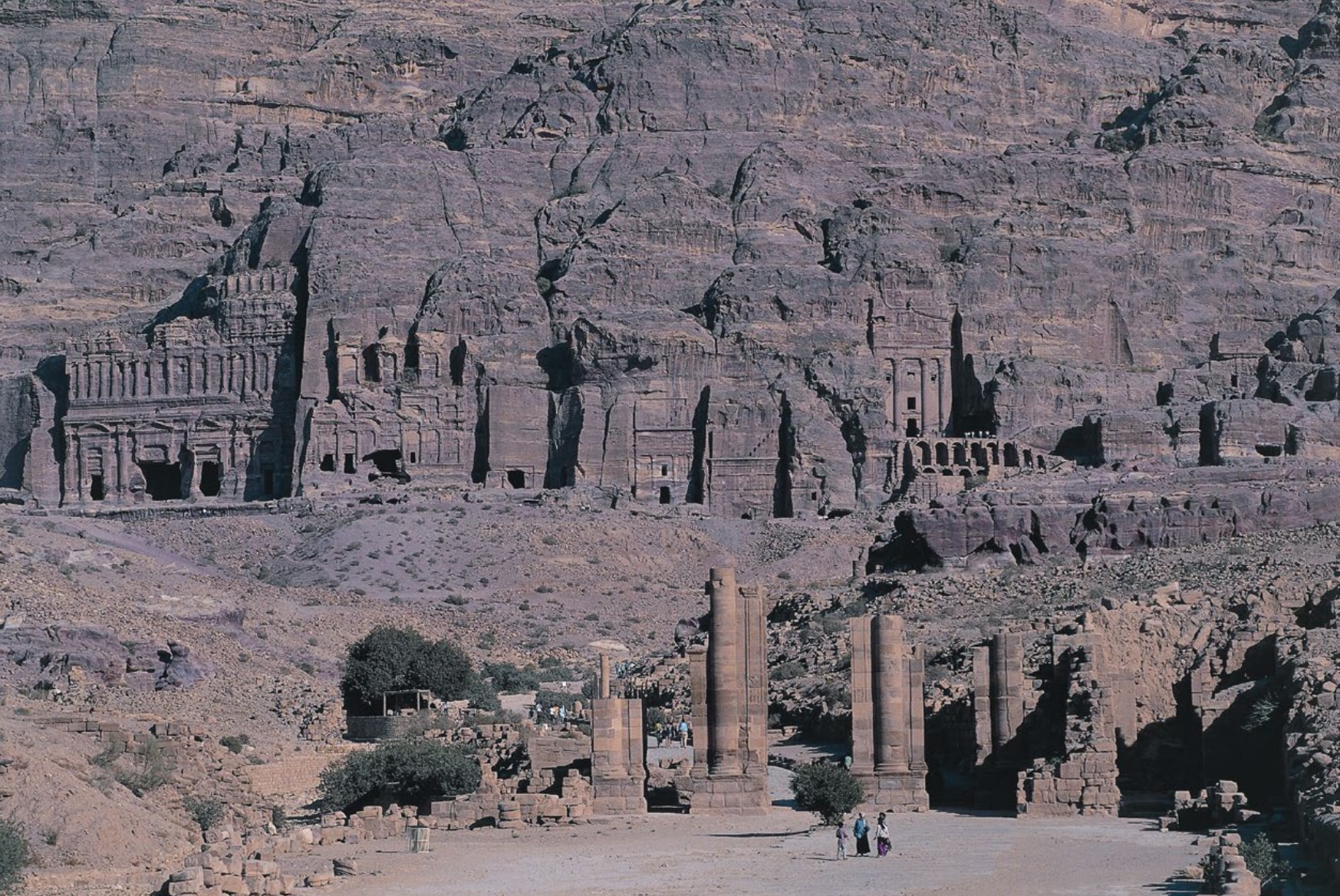
 Petra © De Agostini Picture Library/C. Sappa/The Bridgeman Art Library
Petra, Jordan: Treasury and Great Temple
Nabataean Ptolemaic and Roman. c. 400 B.C.E.–100 C.E. Cut rock.
Curator Note
"The Rose City, lost to the West for centuries. Carved directly into vibrant pink sandstone cliffs, Petra was the wealthy capital of the Nabataean incense trade. The "Treasury" (Al-Khazneh) isn't a bank—it's a royal tomb designed to dazzle traders entering through the narrow Siq canyon."
Form
- Rock-cut architecture: Carved directly into the sandstone cliff face (subtractive method).
- Hellenistic style: Features Corinthian columns, pediments, and tholosses (circular temples).
- Broken pediment: The tintop pediment is split, revealing a central tholos cylinder.
- Naturalistic details: Eagles, amazons, and twin deities (Castor and Pollux) adorn the facade.
- Color: The natural striations of the red/pink sandstone create a vibrant, changing aesthetic.
Function
- Funerary: The "Treasury" was likely a tomb for a Nabataean King (Aretas IV?).
- Trading Hub: Petra was the nexus of the silk and spice routes (incense/myrrh).
- Water Management: A complex system of cisterns and channels allowed life in the desert.
- Political Statement: The blend of Greek, Egyptian, and Assyrian styles showed worldly sophistication.
- Temple: The "Great Temple" was a massive complex for worship and perhaps royal audiences.
Content
- Al-Khazneh (The Treasury): 40 meters tall, the most famous facade.
- Siq: The narrow, mile-long gorge that leads dramatically to the Treasury.
- Syncretism: Isis-Tyche (Egyptian Goddess + Greek Fortune) is depicted in the central tholos.
- Aniconism: Nabataean gods (Dushara) were often represented as blocky stones ("betyls"), not figures.
- Theater: A massive Roman-style theater carved into the rock seats 8,500 people.
Context
- Nabataeans were nomadic Arabs who settled and became wealthy merchant princes.
- Located at the intersection of trade routes between Arabia, Egypt, and Syria.
- Annexed by the Roman Empire (Trajan) in 106 C.E., leading to its eventual decline.
- "Rediscovered" by Swiss explorer Johann Burckhardt in 1812 (disguised as a Bedouin).
- Famous in pop culture (Indiana Jones) but critically endangered by tourism/erosion.