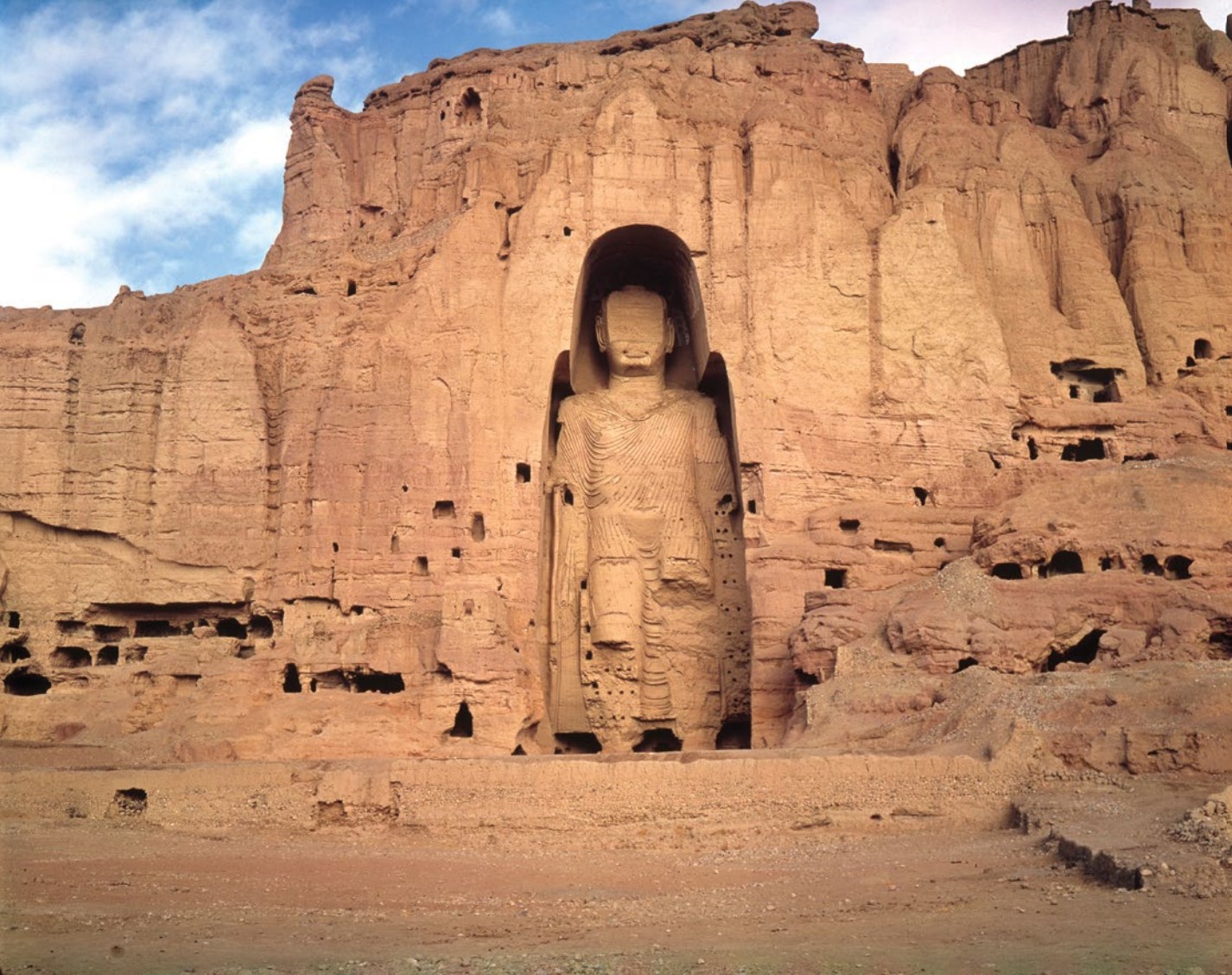
 Buddha © Borromeo/Art Resource, NY
Buddha
Bamiyan, Afghanistan. Gandharan. c. 400–800 C.E. (destroyed in 2001). Cut rock with plaster and polychrome paint.
Curator Note
"The ghosts of the central highlands. Once the largest standing Buddha statues in the world, serving as beacons for Silk Road travelers. They were tragically blown up by the Taliban in 2001, an act of "cultural terrorism" that shocked the world."
Form
- High relief: Carved into the cliff face but still attached at the back.
- Scale: The larger Western Buddha was 175 feet tall; the Eastern was 120 feet.
- Material: Rock core covered in mud plaster/straw, then painted (gold/copper).
- Gandharan Style: Blended Greek flowing drapery (wet drapery) with Indian iconography.
- Circumambulation: Passageways allowed pilgrims to walk around the statue (even at head level).
Function
- Pilgrimage site: A major stop on the Silk Road for Buddhist travelers.
- Devotional object: Allowed for circumambulation and meditation.
- Beacon: The gilded/painted statues would have shone brilliantly across the valley.
- Monastic center: The cliffs are honeycombed with 1,000+ caves for monks.
- Icon of faith: Demonstrated the scale and power of Buddhism in Central Asia.
Content
- Vairocana Buddha (Cosmic Buddha): The larger figure represented the universal aspect.
- Shakyamuni Buddha: The smaller figure represented the historical Buddha.
- Drapery folds: Originally created by ropes attached to the stone before plastering.
- Niche: The arch shaped niche acted as a halo (mandorla).
- Empty niches: Now stand as powerful symbols of loss and memory.
Context
- Bamiyan was a vibrant crossroads of Indian, Greek, Roman, and Sassanian cultures.
- Buddhism thrived here before the Islamic conquest of the region.
- Destruction (2001): Mullah Omar ordered them destroyed as "idols" despite global outcry.
- Debate: Should they be rebuilt with lasers/3D printing, or left empty as a memorial?
- Silk Road importance: Proof that Buddhism spread West before going East to China.