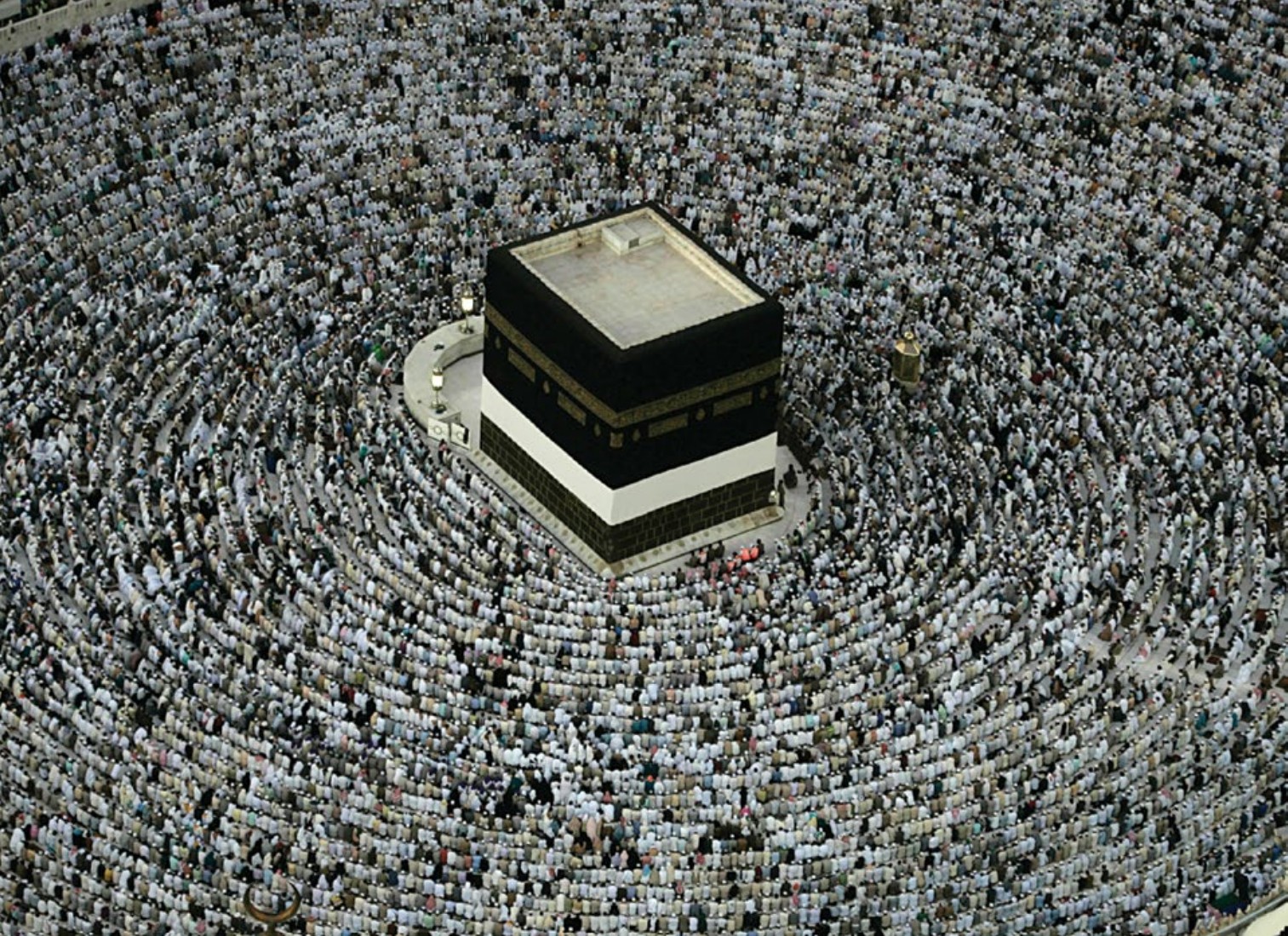
 The Kaaba © ALI JAREKJI/Reuters/Corbis
The Kaaba
Mecca, Saudi Arabia. Islamic. Pre-Islamic monument; rededicated by Muhammad in 631–632 C.E. Granite masonry, covered with silk curtain and calligraphy in gold and silver-wrapped thread.
Curator Note
"The center of the Islamic world. It is the Qibla—the point toward which billions of Muslims pray five times a day. While it is draped in black silk today, its history goes back to Abraham and Ishmael, and arguably to Adam himself."
Form
- Cube shape: Roughly cubic structure (Kaaba means "Cube" in Arabic).
- Material: Granite masonry covered by the Kiswa (black silk cloth with gold embroidery).
- Orientation: Corners align roughly with the cardinal directions.
- Entrance: A single door made of solid gold raised above ground level.
- Interior: Mostly empty, with three pillars and hanging lamps.
Function
- Qibla: The focal point of prayer (Salat) for Muslims worldwide.
- Hajj destination: The destination of the mandatory annual pilgrimage.
- Tawaf: Pilgrims circumambulate (walk around) it seven times counter-clockwise.
- Symbol of Unity: Unifies the Ummah (Muslim community) across all nations.
- House of God: Considered the earthly counterpart to the House of God in heaven.
Content
- The Black Stone (al-Hajar al-Aswad): Meteorite? believed to be given by Gabriel to Abraham.
- Kiswa: The cloth covering, replaced annually (costs millions).
- Calligraphy: Quranic verses embroidered in gold thread.
- Hatim: A low semi-circular wall marking the original footprint (and Ishmael's grave?).
- Sanctuary: The Haram (sacred precinct) surrounding it.
Context
- Pre-Islamic: Was a polytheistic sanctuary housing 360 idols before Muhammad.
- Rededication: Muhammad cleansed it of idols in 630 C.E., returning it to Monotheism.
- Modifications: Has been rebuilt/repaired many times due to floods, fires, and wars.
- Expansion: The surrounding mosque (Masjid al-Haram) is constantly expanded for millions of pilgrims.
- Access: Only Muslims are permitted to enter the city of Mecca.