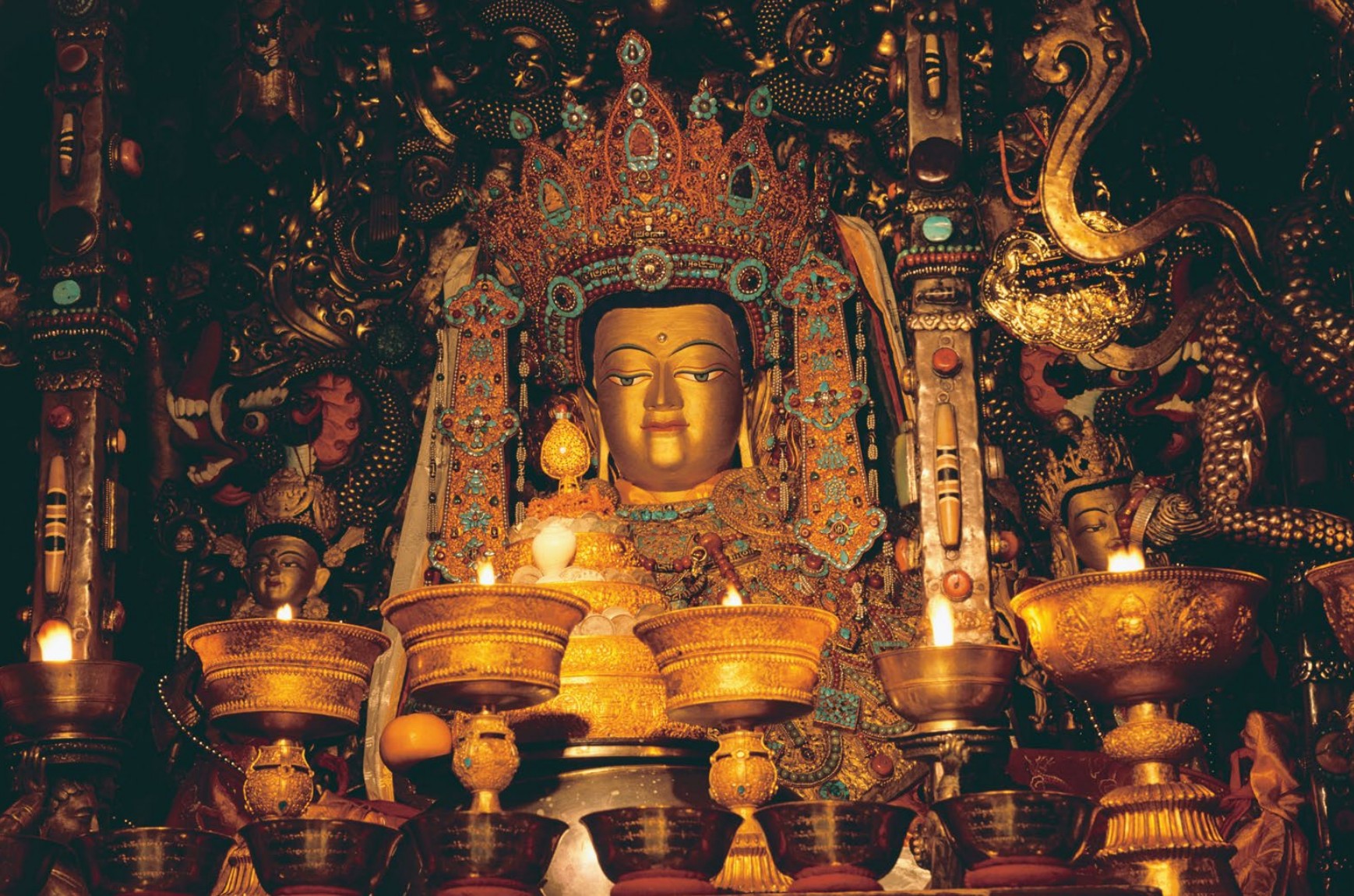
 Jowo Rinpoche © Christophe Boisvieux/Corbis
Jowo Rinpoche, enshrined in the Jokhang Temple
Lhasa, Tibet. Yarlung Dynasty. Believed to have been brought to Tibet in 641 C.E. Gilt metals with semiprecious stones, pearls, and paint; various offerings.
Curator Note
"The most sacred statue in Tibet. Believed to have been carved by the celestial architect Viswakarma during the Buddha's lifetime, making it a true portrait. To see it is to be blessed; its energy is said to transform the viewer."
Form
- Seated Buddha: Lotus position (padmasana) on a gold throne.
- Mudra: Hands in the Bhumisparsha mudra (calling the earth to witness).
- Material: Cast metal (gold/copper alloy) with heavy gilding.
- Decoration: Encrusted with turquoise, coral, and pearls (offerings added over centuries).
- Scale: Life-sized representation of the Buddha at age 12.
Function
- Pilgrimage Goal: The ultimate destination for Tibetan Buddhists (some prostrate all the way to Lhasa).
- Devotion: Worshiped as if it were the living Buddha himself (dressed and fed).
- Healing: Believed to have the power to heal the sick and grant wishes.
- Political Legitimacy: Possession of the statue conferred right to rule Tibet.
- Cultural Identity: The heart of Tibetan Buddhism.
Content
- Jowo Rinpoche: "Precious Lord." represents Shakyamuni Buddha.
- Crown: Elaborate five-leafed crown (added later by Tsongkhapa).
- Smile: A serene, compassionate expression.
- Vajra: A thunderbolt symbol placed in front of him.
- Offerings: Surrounded by butter lamps and scarves (khata).
Context
- Brought to Tibet (641 C.E.) as a dowry by Chinese Princess Wencheng (marriage to Songtsen Gampo).
- The Jokhang Temple was built specifically to house this statue.
- Cultural Revolution: Hidden and damaged in the 1960s, later restored.
- Significance: Represents the arrival of Buddhism in Tibet.
- Location: Lhasa ("Place of the Gods").