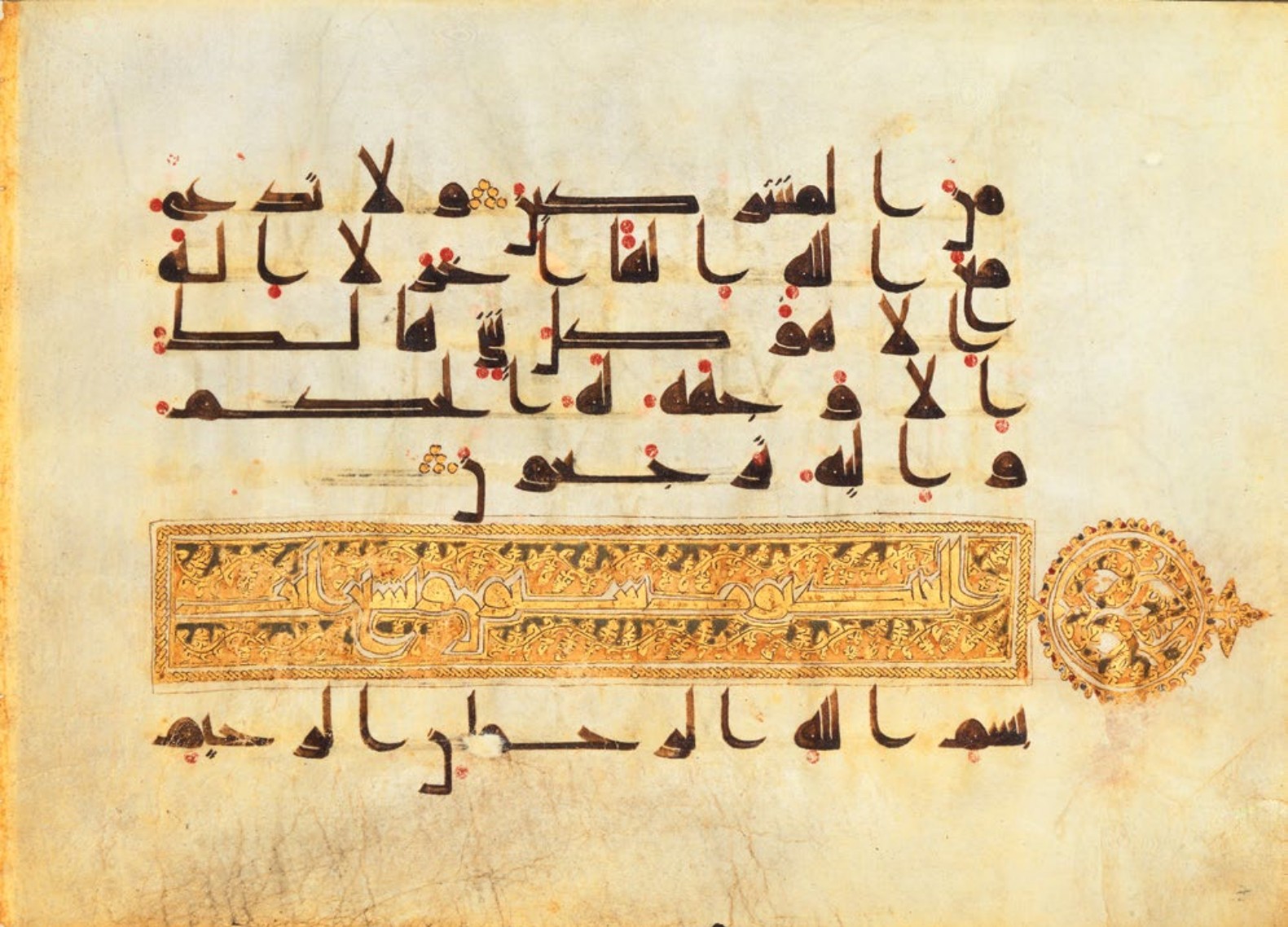
 Folio from a Qur’an © The Pierpont Morgan Library/Art Resource, NY
Folio from a Qur’an
Arab, North Africa, or Near East. Abbasid. c. 8th to 9th century C.E. Ink, color, and gold on parchment.
Curator Note
"Sacred geometry of text. In a culture where figural art was discouraged in religious contexts, calligraphy became the highest art form. The scribe carefully planned the negative space so that the word of God would float beautifully on the page."
Form
- Kufic script: An angular, rectilinear early Arabic script.
- Material: Parchment (animal skin) primed to be smooth.
- Orientation: Landscape format (horizontal), unlike later vertical books.
- Precision: The scribe used interlines (guidelines) to ensure consistent height.
- Vocalization: Red dots indicate vowels; gold rectanlges mark verse endings.
Function
- Sacred Text: Recording the revelation of Allah to Muhammad.
- Recitation aid: Large, clear script helped multiple readers recite from one book (mashq).
- Devotion: The act of copying the Quran was a form of prayer and merit-making.
- Status: High-quality materials (gold, parchment) indicated a wealthy patron.
- Preservation: Ensuring the oral tradition was fixed in written form.
Content
- Surah Al-Ankabut (The Spider): The text shown in this specific folio.
- Gold Sura Heading: An ornamental band marks the start of a new chapter.
- Palmette: A vegetal ornament extending from the sura heading into the margin.
- Proportion: The height of the letters is strictly module-based (width of the nib).
- Negative space: The emptiness is as important as the ink.
Context
- Abbasid Caliphate: A Golden Age of Islamic art and science (Baghdad/Kairouan).
- Paper revolution: This was made just before paper replaced parchment (cheaper/easier).
- Evaluation: Calligraphers were the highest-status artists in the Islamic world.
- Literacy: The spread of Islam encouraged high literacy rates.
- Survival: Individual pages survive because manuscripts were unbound and sold separately.