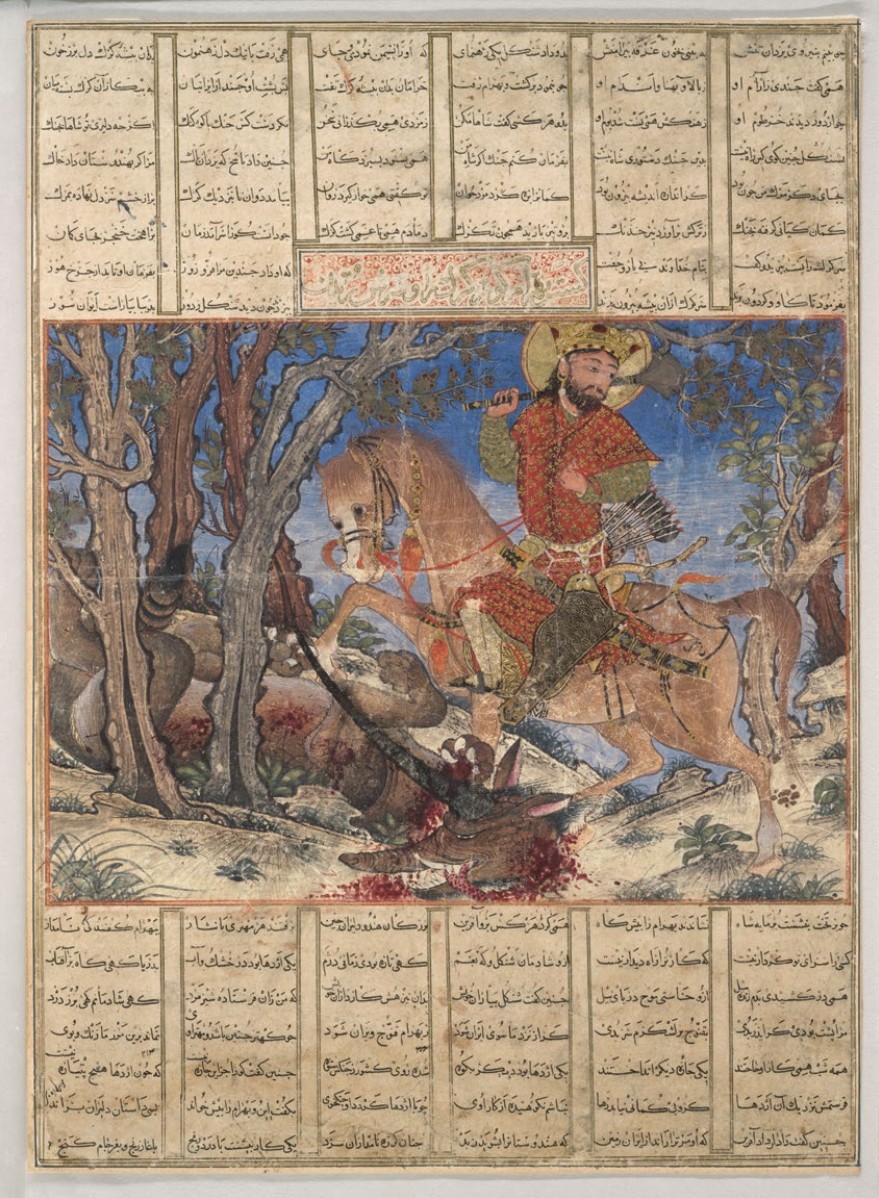
 Bahram Gur Fights the Karg Reproduction print used by permission of the Harvard Art Museums
Bahram Gur Fights the Karg
Islamic; Persian, Il’Khanid. c. 1330–1340 C.E. Ink and opaque watercolor, gold, and silver on paper.
Curator Note
"A Persian hero fighting a unicorn-wolf. Bahram Gur, an ancient Sassanian King, is depicted in a Mongol style (wearing silks, Asian features) within a Persian epic poem. It shows how the Mongol conquerors (Il-Khanids) adopted Persian culture to legitimize their rule."
Form
- Media: Ink, opaque watercolor, gold, silver on paper.
- Style: Synthesis of Chinese landscape (twisted trees, rocks) and Persian narrative.
- Action: Dynamic composition showing the moment of the kill.
- Costume: Bahram Gur wears European fabric? but Mongol armor/crown.
- Perspective: Flat, stacked perspective typical of Persian miniatures.
Function
- Book Illustration: Part of the "Great Mongol Shahnama" (Book of Kings).
- Legitimation: The Mongols wanted to link themselves to the ancient Persian kings.
- Education: Teaching the moral virtues of kingship (bravery/justice).
- Prestige: Commissioned by the Vizier for the Royal Library.
- Entertainment: Recited and viewed in courtly gatherings.
Content
- Bahram Gur: Sassanian King (historical figure) idealized as a hero.
- The Karg: A mythical horned wolf/unicorn/rhino beast.
- Weaponry: Bow and arrow, mace, sword (Mongol weaponry).
- Chinese motifs: The background landscape is clearly influenced by Chinese scrolls.
- Halo: Bahram Gur has a halo, signifying royal glory (farr).
Context
- Shahnama: The Persian national epic written by Firdawsi (c. 1000 C.E.).
- Il-Khanids: Mongols who ruled Persia; brought Chinese art influence (Silk Road).
- Tabriz style: The workshop where this masterpiece was created.
- Cultural Assimilation: Conquerors adopting the culture of the conquered.
- The manuscript was broken up and sold page by page in the 20th century.