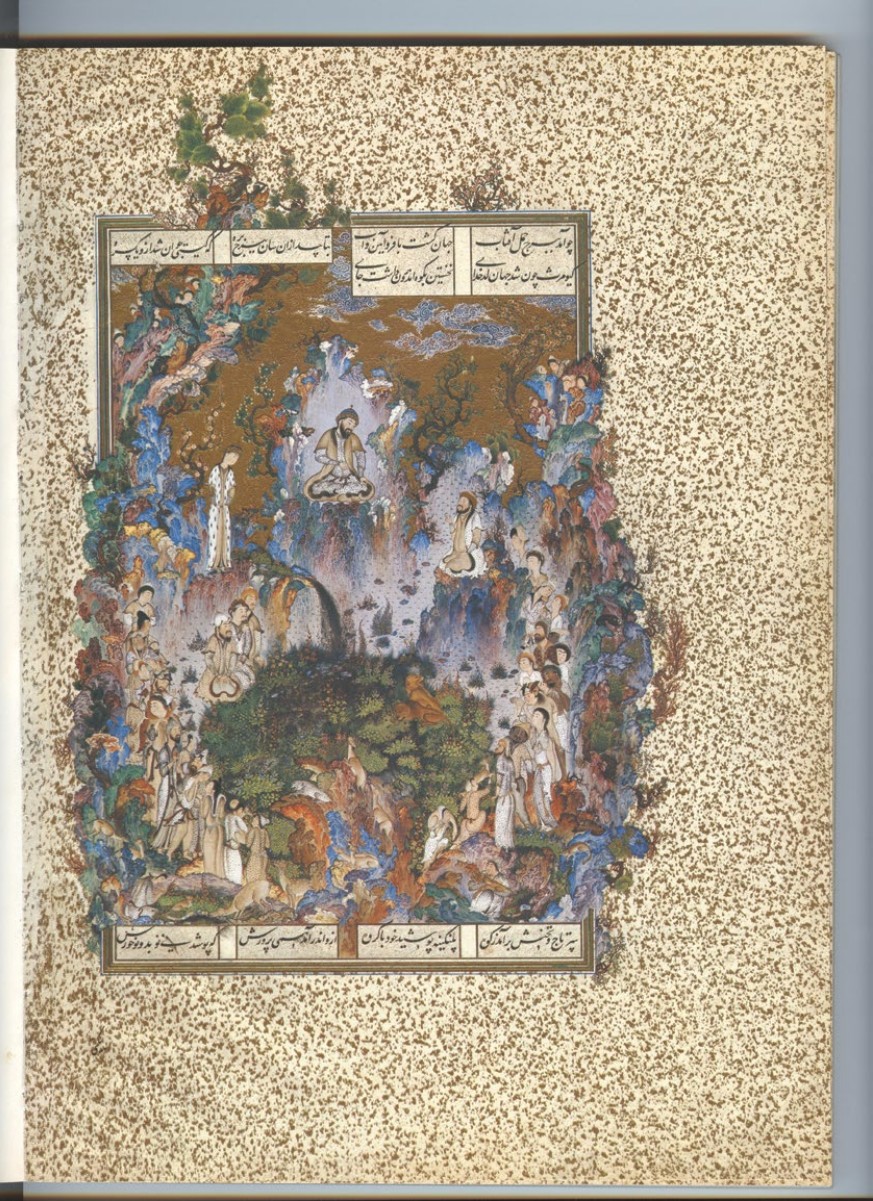
 The Court of Gayumars Courtesy of Wikimedia
The Court of Gayumars
Folio from Shah Tahmasp’s Shahnama. Sultan Muhammad. c. 1522–1525 C.E. Ink, opaque watercolor, and gold on paper.
Curator Note
"The jewel of Persian painting. Depicting the first legendary King, Gayumars, ruling from a mountaintop when humans and animals lived in peace. The painting literally breaks the frame—trees and clouds spill out into the gold-speckled margins."
Form
- Detail: Incredible miniaturization (painted with single-hair brushes).
- Composition: Levitation/Floating arrangement; circular unity around the King.
- Colors: Jewel-like lapis lazuli, gold, turquoise, and coral.
- Format: Vertical page breaking the borders (spilling out).
- Atmosphere: A mystical, ethereal quality (Sufi influence?).
Function
- Royal Gift: Created for Shah Tahmasp, later gifted to Ottoman Sultan Selim II.
- Display of power: Showed the immense resources/talent of the Safavid court.
- Mythology: Illustrating the Golden Age of mankind.
- Meditation: The detail invites hours of close inspection.
- Diplomacy: Used to improve relations between Rival empires (Safavid vs Ottoman).
Content
- Gayumars: The first King, seated at the top on a leopard skin.
- Hushang (Grandson): Seated to the left.
- Siyamak (Son): Seated to the right (fated to die fighting the Black Div).
- Courtiers: Wearing leopard skins, living in harmony with animals.
- Hidden faces: The rocks reveal hidden grotesque faces (spirits?).
Context
- Shah Tahmasp's Shahnama: The most luxurious version ever produced (258 paintings).
- Safavid Dynasty: High point of Persian art (Tabriz school).
- Artist: Sultan Muhammad was the master of the royal workshop.
- Fate: The book was broken up ("The Houghton Shahnama") and dispersed; this page is in the Aga Khan Museum.
- Themes: Investigates the burden of kingship and the transience of life.