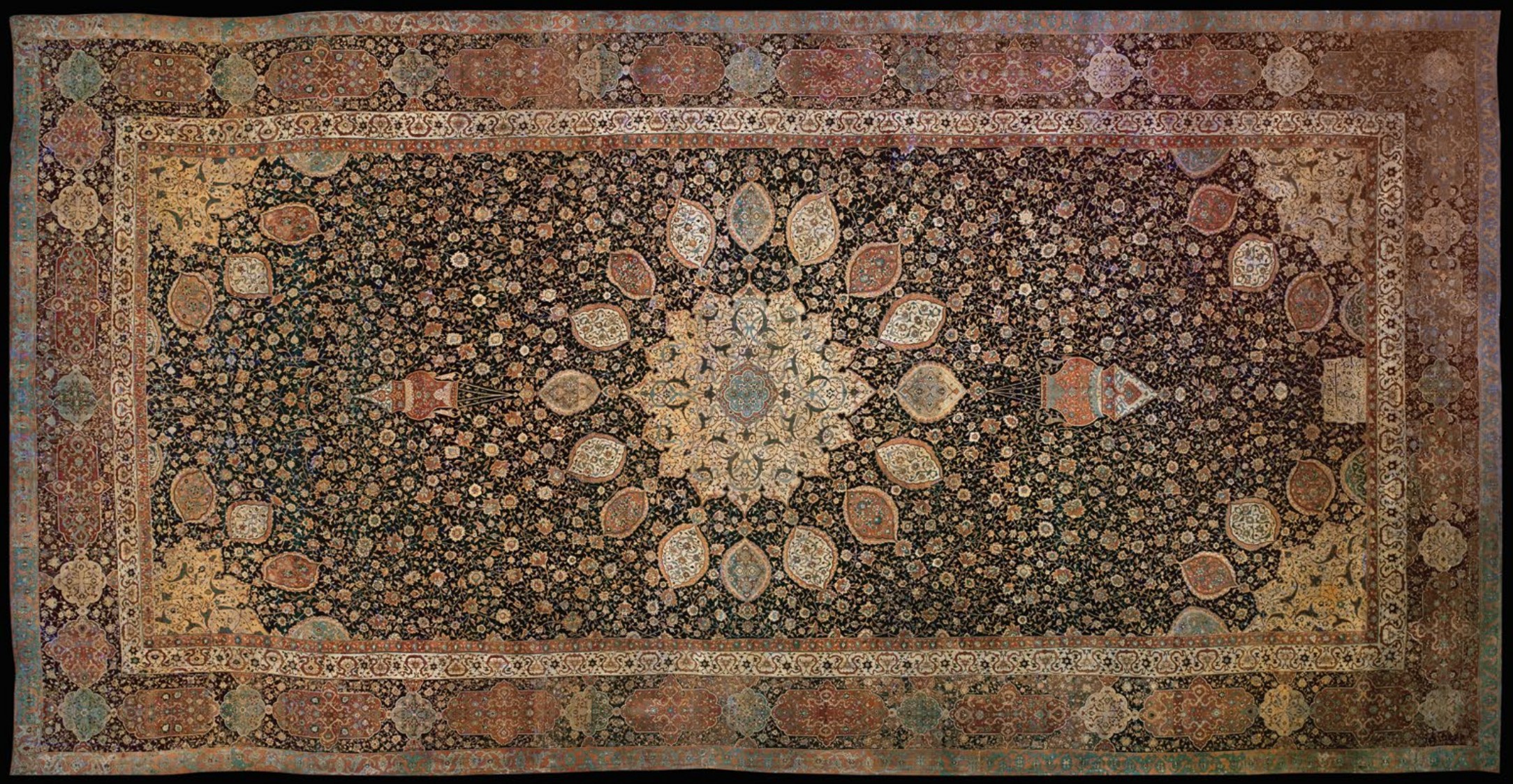
 The Ardabil Carpet © Victoria & Albert Museum, London, UK/The Bridgeman Art Library
The Ardabil Carpet
Maqsud of Kashan. 1539–1540 C.E. Silk and wool.
Curator Note
"One of a pair for a shrine. It is one of the world's oldest and largest Islamic carpets. The design is so precise that the hanging lamps are different sizes to account for perspective when viewed from the entrance—optical illusion in wool."
Form
- Material: Silk warps/wefts with wool pile (25 million knots).
- Knot count: Extremely high (340 knots per sq inch), allowing detailed design.
- Dyes: Natural dyes (pomegranate/indigo) that have held color for 500 years.
- Symmetry: Perfectly balanced radial symmetry.
- Size: Massive (34 x 17 feet).
Function
- Funerary: Made for the shrine of Safi al-Din Ardabili (Sufi saint/ancestor of the dynasty).
- Pair: Originally one of two matching carpets (the other is in LA and sacrificed to repair this one).
- Devotion: Woven as an act of piety.
- Acoustics: Softened the sound in the shrine.
- Status: Demonstrated the power of the Safavid state sponsorship.
Content
- Central Sunburst: Represents the dome of heaven or a lotus.
- Hanging Lamps: Two lamps hang from the center (one larger than the other for perspective effect).
- Cartouches: Rectangular boxes containing poetry by Hafiz.
- Inscription: Includes the artist's name (Maqsud) and the date (AH 946).
- Vegetal patterns: Vines and flowers cover the dark blue "pool" background.
Context
- Safavid Period: A golden age of textile production (Royal factories).
- Location: The Shrine in Ardabil, Azerbaijan (northwest Iran).
- Artist: Maqsud was not the weaver, but the designer/overseer.
- Provenance: Sold in the 19th century to fund shrine repairs; bought by the V&A Museum (London).
- Legacy: Defining example of the "Persian Carpet" aesthetic.