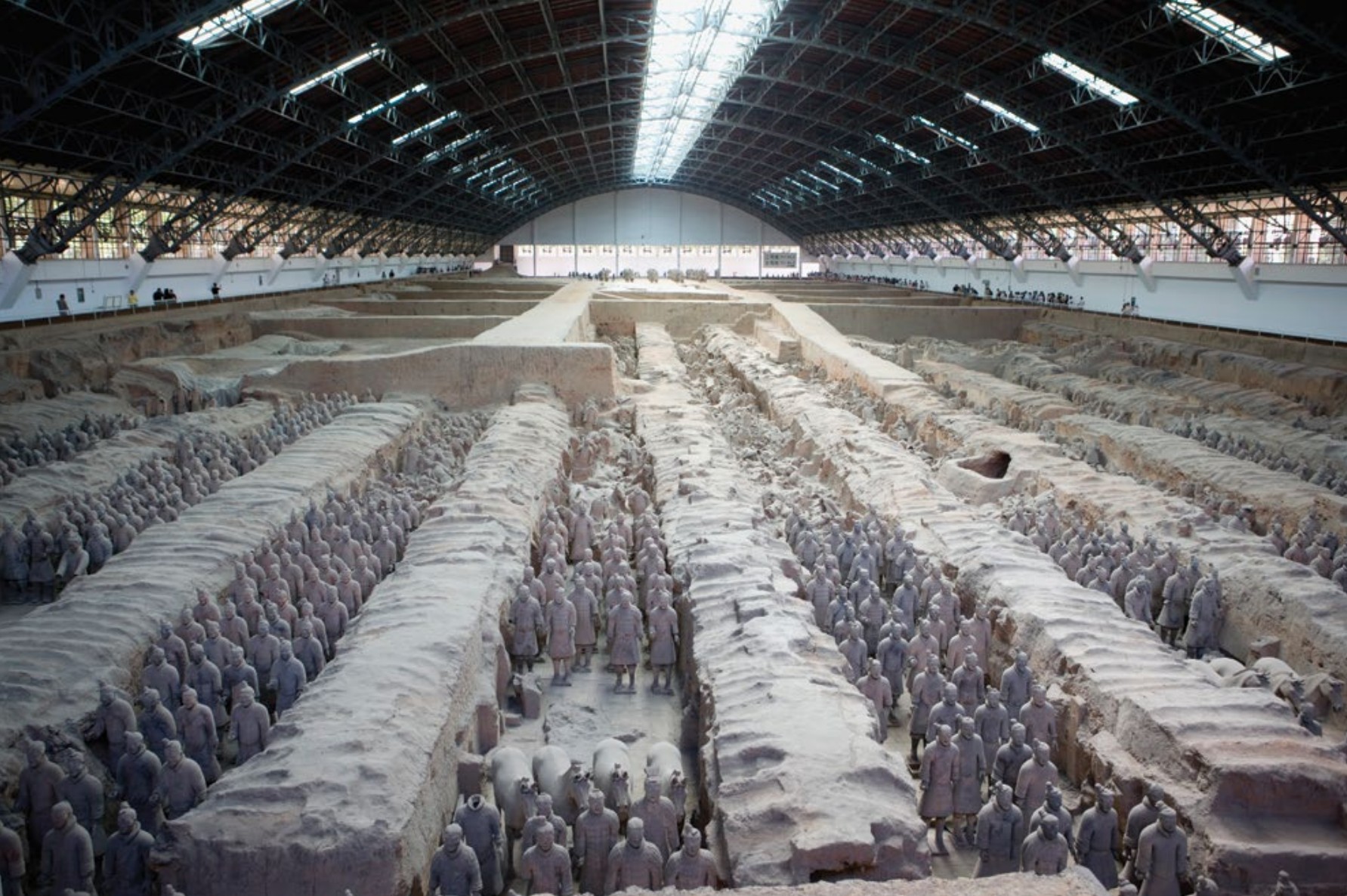
 Terracotta warriors © Imagemore Co., Ltd./Corbis
Terracotta warriors
Mausoleum of the first Qin emperor of China. Qin Dynasty. c. 221–209 B.C.E. Painted terra cotta.
Curator Note
"An immortal army for the afterlife. Emperor Qin Shi Huang, obsessed with immortality, took an entire army with him to conquer death. 8,000 soldiers, horses, and chariots—each with a unique face—stand in battle formation, protecting his tomb. It is a staggering display of absolute power and mass production."
Form
- Medium: Terracotta (baked clay), originally brightly painted (lacquer).
- Scale: Life-size figures (slightly larger than average height, approx 6ft).
- Individualization: Assembly-line bodies but hand-finished individual faces.
- Quantity: Over 8,000 soldiers, 130 chariots, 520 horses found so far.
- Technique: Coiling method for bodies, molds for heads, assembled in parts.
Function
- Funerary Art: To protect the Emperor in the afterlife.
- Power Projection: Demonstarted the Emperor's infinite resources and command.
- Substitute: Replaced the ancient practice of human sacrifice (a humane upgrade).
- Microcosm: Part of a larger necropolis recreating the entire court unique universe.
- Immortality: To ensure the Emperor could rule forever in the spirit world.
Content
- Ranks: Archers, infantry, cavalry, and officers (generals are taller).
- Detail: Armor rivets, shoe treads, and hair knots are meticulously rendered.
- The Tomb Mound: The actual tomb of the Emperor remains unexcavated (rumored rivers of mercury).
- Formation: Three pits arranged in strict military battle formation.
- Weaponry: Originally held real bronze weapons (swords, crossbows), many looted.
Context
- Qin Shi Huang: The first Emperor to unify China (brutal legalist ruler).
- Unification: He standardized writing, currency, weights, and built the Great Wall.
- Legalism: A philosophy emphasizing strict laws and absolute power.
- Discovery: Found by farmers digging a well in 1974.
- Labor: 700,000 laborers worked on the complex (many died/killed).