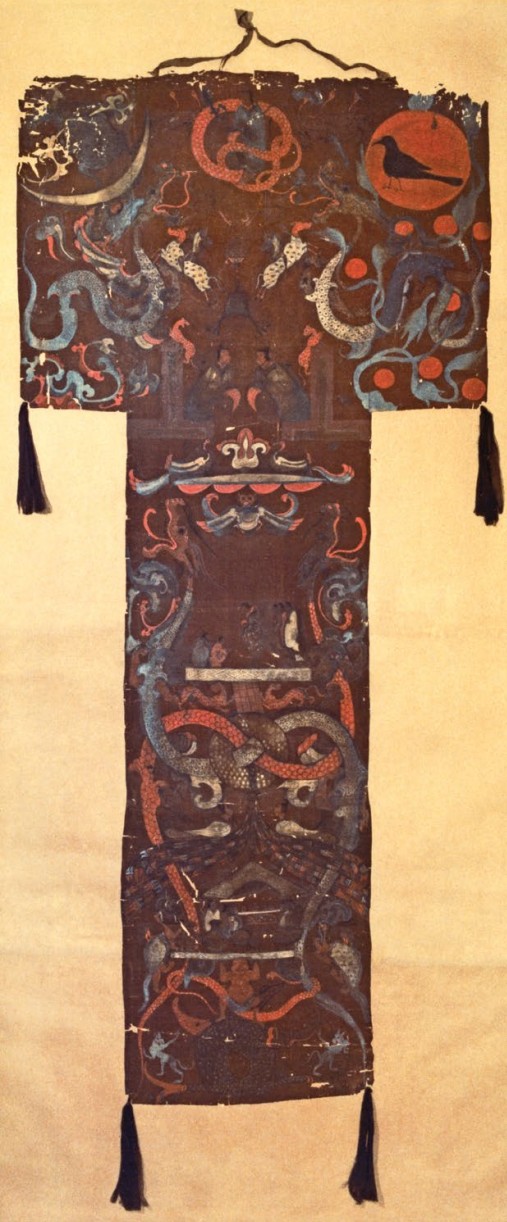
 Funeral banner of Xian © Bettman/Corbis
Funeral banner of Lady Dai (Xin Zhui)
Han Dynasty, China. c. 180 B.C.E. Painted silk.
Curator Note
"A roadmap to heaven. Found draped over the innermost coffin of a noblewoman, this T-shaped silk banner maps the journey of her soul. From the underworld to the high heavens, it blends Daoist mythology with Confucian respect for ancestors, ensuring Lady Dai finds her way to immortality."
Form
- Format: T-shaped silk banner.
- Medium: Painted silk (very expensive material).
- Composition: Divided into four horizontal registers (Heaven, Lady Dai, Mourning, Underworld).
- Symmetry: Balanced left/right composition reflecting cosmic order.
- Color: Rich mineral pigments still vibrant after 2,000 years.
Function
- Funerary: Carried in the funeral procession, then draped on the coffin.
- Guide: Used to attract and guide the spirit of the deceased to the afterlife.
- Identification: "Name Banner" identifying the occupant to the gods.
- Status: Displayed the wealth and piety of the Marquis of Dai's family.
- Immortality: Part of the quest for eternal life (along with the preserved body).
Content
- Lady Dai: Depicted in the center, leaning on a cane, waiting to ascend.
- Heaven (Top): Sun (with crow), Moon (with toad), and Nu Wa (creator deity).
- Underworld (Bottom): Fish, turtles, and a strong man holding up the earth.
- Mourning Scene: Family offering food/sacrifices to Lady Dai's corpse.
- Dragons: Intertwined dragons connect the realms (symbols of imperial power).
Context
- Han Dynasty: A golden age of Chinese culture, contemporary with Rome.
- Daoism/Confucianism: The art reflects a syncretic mix of beliefs (Yin/Yang balance).
- Preservation: Lady Dai's body was so well preserved her skin was still soft.
- Mawangdui Tombs: The site yielded thousands of artifacts (lacquerware, texts).
- Respect: Filial piety (respect for parents) extended beyond death.