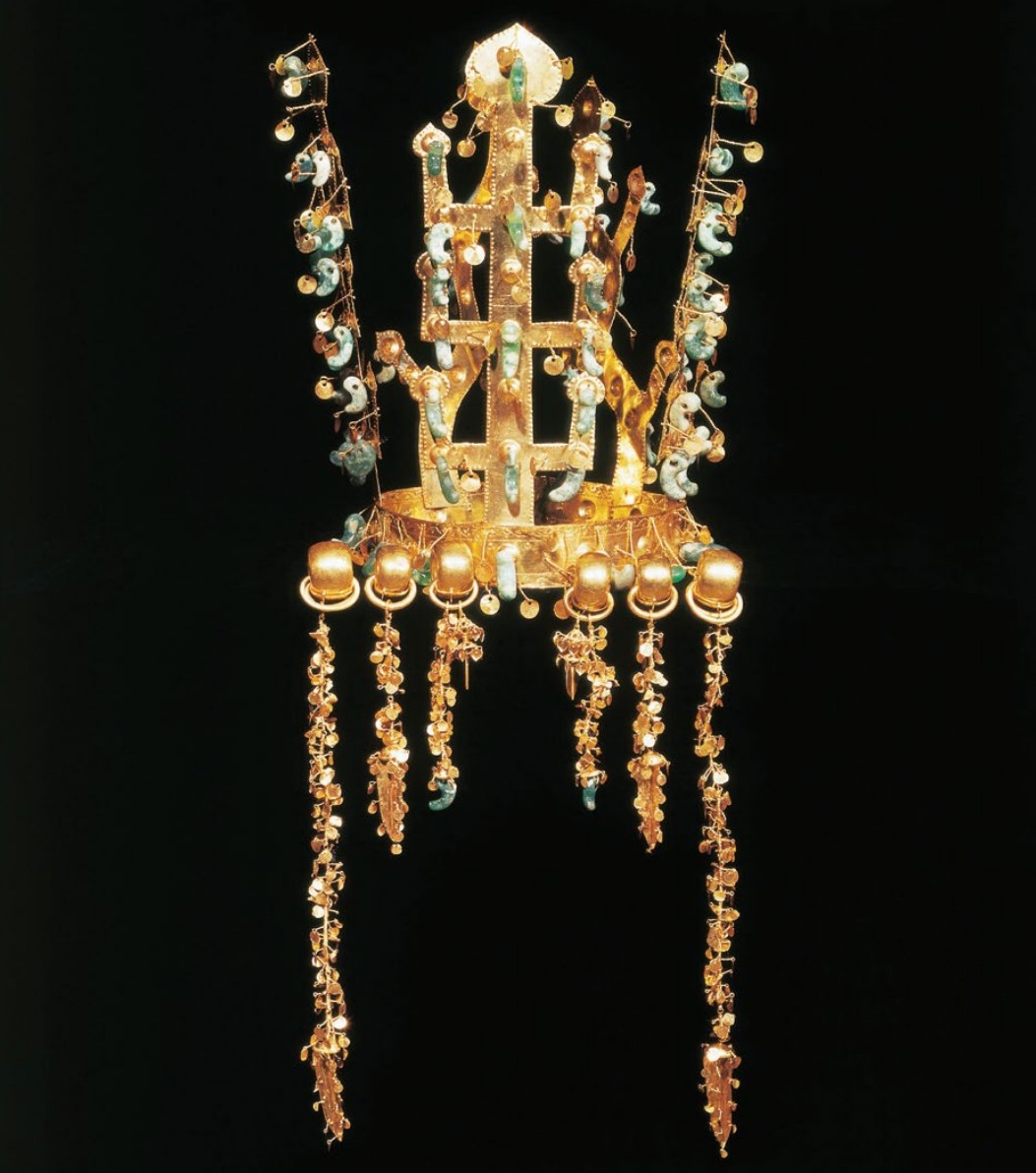
 Gold and jade crown © DeA Picture Library/Art Resource, NY
Gold and jade crown
Three Kingdoms Period, Silla Kingdom, Korea. Fifth to sixth century C.E. Metalwork.
Curator Note
"Shamanistic splendor. Before Buddhism took hold, the Korean Silla kings were shaman-rulers. This fragile, glittering crown, laden with jade ornaments (gogok), looks like a golden tree or deer antlers—symbols of the sacred World Tree connecting heaven and earth."
Form
- Material: Thin sheets of gold and green jade (gogok).
- Technique: Cut gold sheet, embossed, connected with wire.
- Shape: Three branch-like protrusions and two antler-like prongs.
- Fragility: Too flimsy for daily wear; likely for burial or ceremonial use only.
- Movement: The dangling jade/gold discs would shimmer and make noise.
Function
- Burial Object: Found in a royal tomb (Hwangnam Daechong).
- Status Symbol: Marked the supreme rank of the Silla royalty.
- Ritual Regalia: Worn by the Shaman-King in ceremonies to channel spirits.
- Connection: Linked the ruler to the "World Tree" (Axis Mundi).
- Display: Showcased the wealth of the "City of Gold" (Gyeongju).
Content
- Tree motif: Represents the sacred tree (connection to heaven).
- Antler motif: Represents the reindeer (native to the Eurasian steppe).
- Gogok: Comma-shaped jade ornaments symbolizing fertility/fruit/fetus.
- Light: Designed to catch and reflect light (sun worship?).
- Nature worship: Elements are derived from nature, not abstract geometry.
Context
- Silla Kingdom: One of the Three Kingdoms of ancient Korea.
- Silk Road connection: Design links to Scythian/Siberian shaman crowns (Afghanistan).
- Shamanism: The native religion before the state adopted Buddhism.
- Burial customs: Silla tombs were mounded tumuli containing vast treasures.
- Eurasian Steppe: Shows Korea's connection to the vast nomadic cultures of the north.