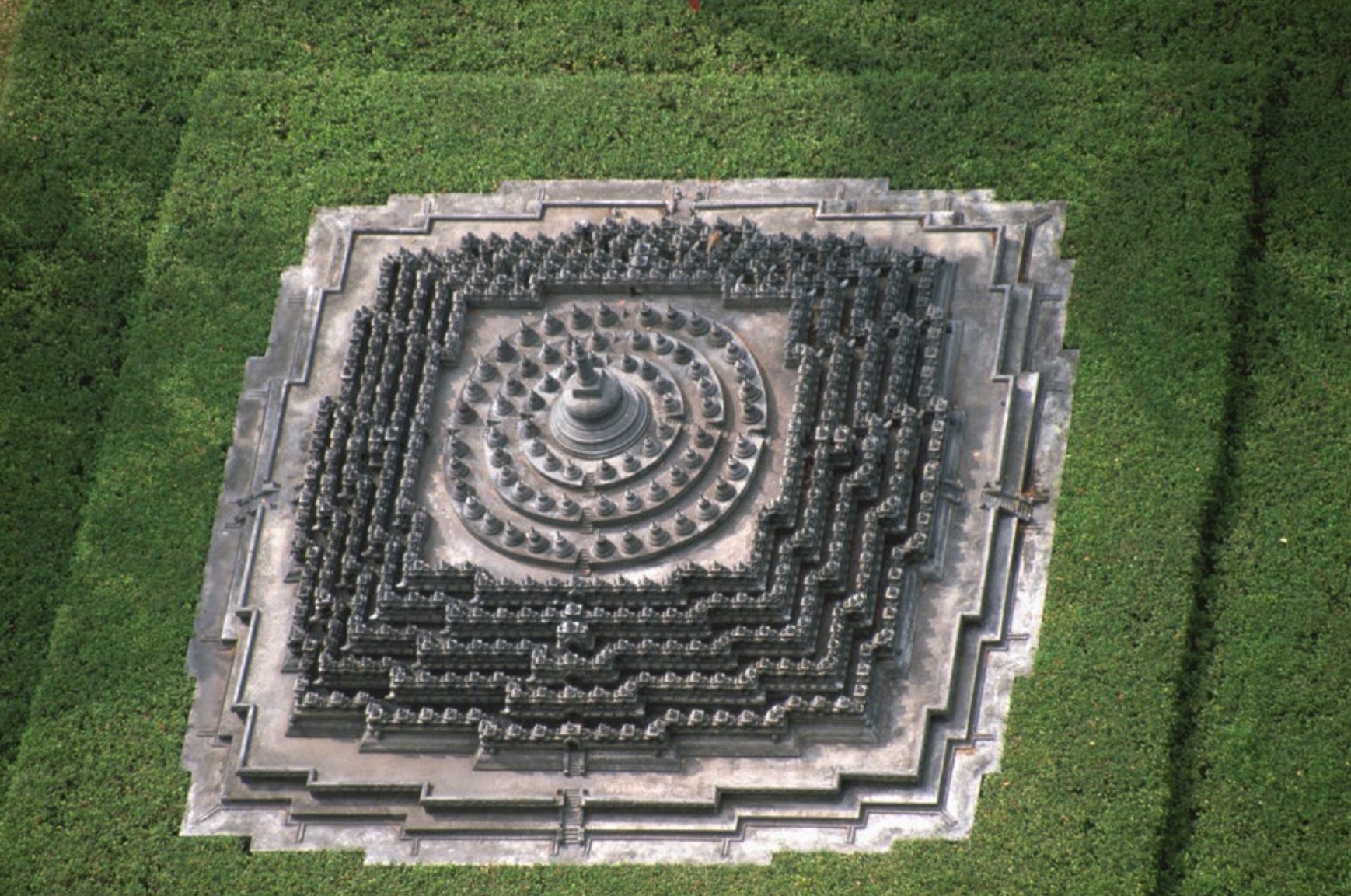
 Borobudur Temple © Charles & Josette Lenars/Corbis
Borobudur Temple
Central Java, Indonesia. Sailendra Dynasty. c. 750–842 C.E. Volcanic stone masonry.
Curator Note
"A mountain of enlightenment. This massive step‐pyramid is a 3D guide to the Buddhist path. As pilgrims climb from the dark base (world of desire) to the open, circular top (world of formlesness), they physically enact the spiritual journey from ignorance to Nirvana, surrounded by 72 stupas."
Form
- Plan: A mandala (cosmic diagram) when viewed from above.
- Structure: A stepped pyramid built around a natural hill.
- Material: Dark volcanic stone masonry (andesite).
- Levels: 3 zones (Kamadhatu, Rupadhatu, Arupadhatu).
- Reliefs: Over 2,500 carved panels and 504 Buddha statues.
Function
- Pilgrimage: A site for physical and spiritual circumambulation.
- Didactic: The reliefs teach the law of karma and the life of Buddha.
- Stupa: Technically, the whole monument is one giant stupa.
- Monument: A testimony to the power of the Sailendra Dynasty.
- Ascension: Mimics the climb up Mt. Meru (sacred mountain).
Content
- Base (Hidden Foot): Reliefs showing the ugly reality of desire/hell.
- Square Terraces (Form): Reliefs of Buddha's life (Jatakas, Sudhana's journey).
- Circular Terraces (Formlessness): No reliefs, just perforated stupas enclosing Buddhas.
- Central Stupa: The empty pinnacle representing Nirvana/Void.
- Buddha Statues: Mudras change as you face different cardinal directions.
Context
- Sailendra Dynasty: "Lords of the Mountain," maritime empire in Java.
- Buddhism: Mahayana/Vajrayana Buddhism thrived here.
- Abandonment: Buried by volcanic ash and jungle for centuries (rediscovered by Raffles).
- Syncretism: Blended Indian forms with Javanese ancestor worship (terraced mountains).
- Restoration: Saved by UNESCO (dismantled and reassembled tone by stone).