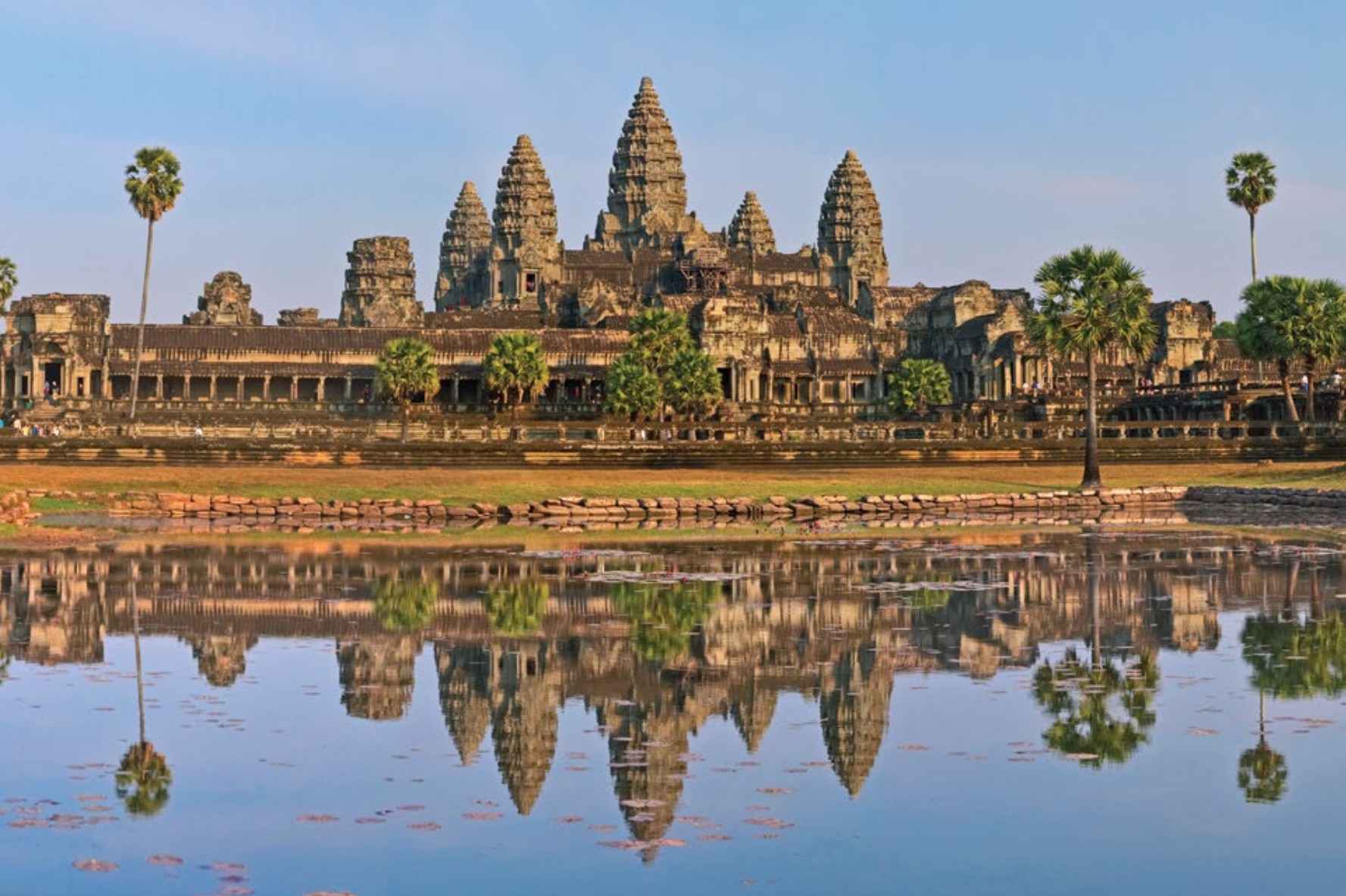
 Angkor Wat © Michele Falzone/JAI/Corbis
Angkor, the temple of Angkor Wat
Cambodia. Hindu, Angkor Dynasty. c. 800–1400 C.E. Stone masonry, sandstone.
Curator Note
"Heaven on Earth. The largest religious monument in the world, Angkor Wat was built to represent Mt. Meru (home of the gods). Surrounded by a vast moat (the cosmic ocean), it was dedicated to Vishnu by King Suryavarman II, who intended it as his tomb and his claim to divinity."
Form
- Plan: Quincunx (four towers surrounding a central peak) + concentric galleries.
- Moat: Massive rectangular waterway stabilizing the foundation.
- Material: Sandstone blocks (floating via canals) and laterite.
- Orientation: Faces WEST (associated with Vishnu and death), unlike most Hindu temples.
- Reliefs: Miles of bas-reliefs including the famous "Churning of the Ocean of Milk".
Function
- State Temple: Center of the Khmer capital.
- Mausoleum: King Suryavarman II's ashes were likely placed here.
- Cosmic Model: Represents Mt. Meru surrounded by oceans.
- Legitimacy: Proved the King's connection to the gods (Devaraja/God-King).
- Observatory? Alignments with the sun (solstice) suggest astronomical use.
Content
- Churning of the Ocean of Milk: Gods and Demons pulling a snake (Naga) to create the elixir of life.
- Apsaras: 2,000+ heavenly nymphs, each with unique hairstyles.
- Vishnu: The Preserver god to whom the temple is dedicated.
- Suryavarman II: Depicted in the reliefs holding court (in glorious shade).
- Jayavarman VII: Later additions (Angkor Thom) introduced Buddhist faces.
Context
- Khmer Empire: Dominated Southeast Asia; masters of water management (Barays).
- Religion: Shifted between Hinduism and Buddhism depending on the King.
- Jayavarman VII: Built the nearby Bayon (Buddhist) with the giant smiling faces.
- Engineering: The water table/moat prevents the temple from collapsing in the swampy soil.
- Abandonment: Reclaimed by the jungle, but never fully forgotten by locals.