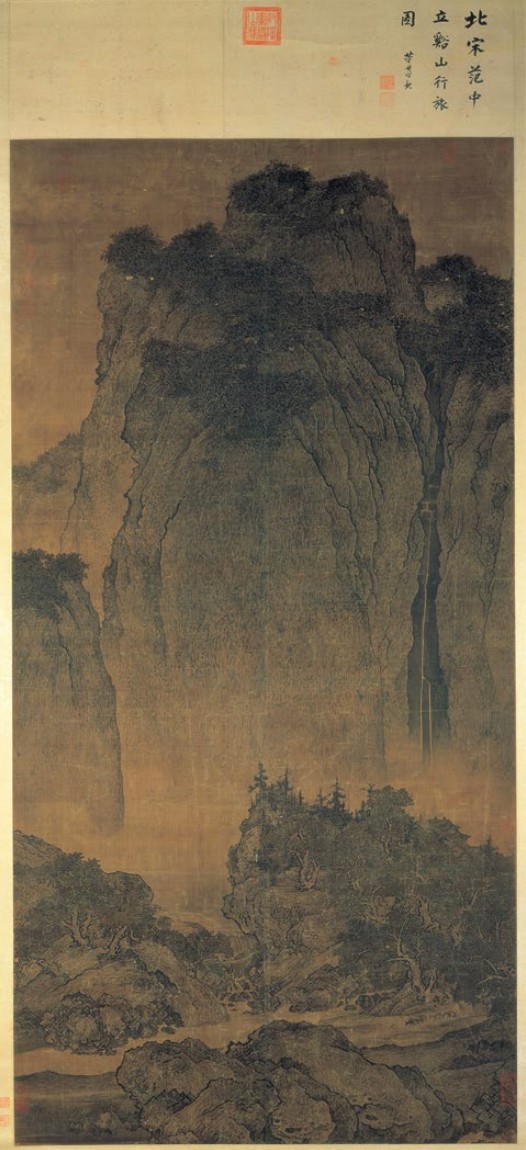
 Travelers among Mountains and Streams © Fan Kuan/Corbis
Travelers among Mountains and Streams
Fan Kuan. c. 1000 C.E. Ink and colors on silk.
Curator Note
"Nature is vast; man is tiny. Fan Kuan, a Daoist recluse, captured the essence (Li) of nature, not just its appearance. The massive mountain dominates the composition, while the tiny mule train at the bottom emphasizes the insignificance of humans in the grand cosmic order."
Form
- Medium: Ink on silk hanging scroll.
- Composition: Tripartite (Foreground rocks, Middle ground mist, Background mountain).
- Brushwork: "Raindrop strokes" (cun) for texture; crisp outline strokes.
- Perspective: Shifting perspective (multiple vanishing points)—we look up, straight, and down.
- Monochrome: Relies on ink wash/tonality rather than color.
Function
- Daoist Meditation: Visualizing the balance of Yin (mist/water) and Yang (mountain/stone).
- Neo-Confucianism: The mountain represents the Emperor/Order hierarchy.
- Personal Expression: Fan Kuan retreated from society to find truth in nature.
- Hanging Scroll: Displayed temporarily for contemplation, not permanently.
- Search for "Li": Trying to capture the absolute principle/truth of the landscape.
Content
- The Mountain: Occupies 2/3 of the scroll; the "host" peak flanked by "guest" peaks.
- Waterfall: A thin white line balancing the mass of rock (void vs solid).
- Travelers: Tiny figures with mules driving through the forest (scalability).
- Temple: A hidden temple roof in the trees (humans living in harmony).
- Signature: Hidden among the leaves (humility).
Context
- Song Dynasty: High point of Chinese landscape painting (Shan Shui).
- Philosophy: Neo-Confucianism blended with Daoism (Nature as moral order).
- Fan Kuan: A hermit who famously said "better to learn from nature than from art".
- Monumental Landscape: Established the standard for the Northern Song style.
- Survival: One of the few undisputed originals from this period.