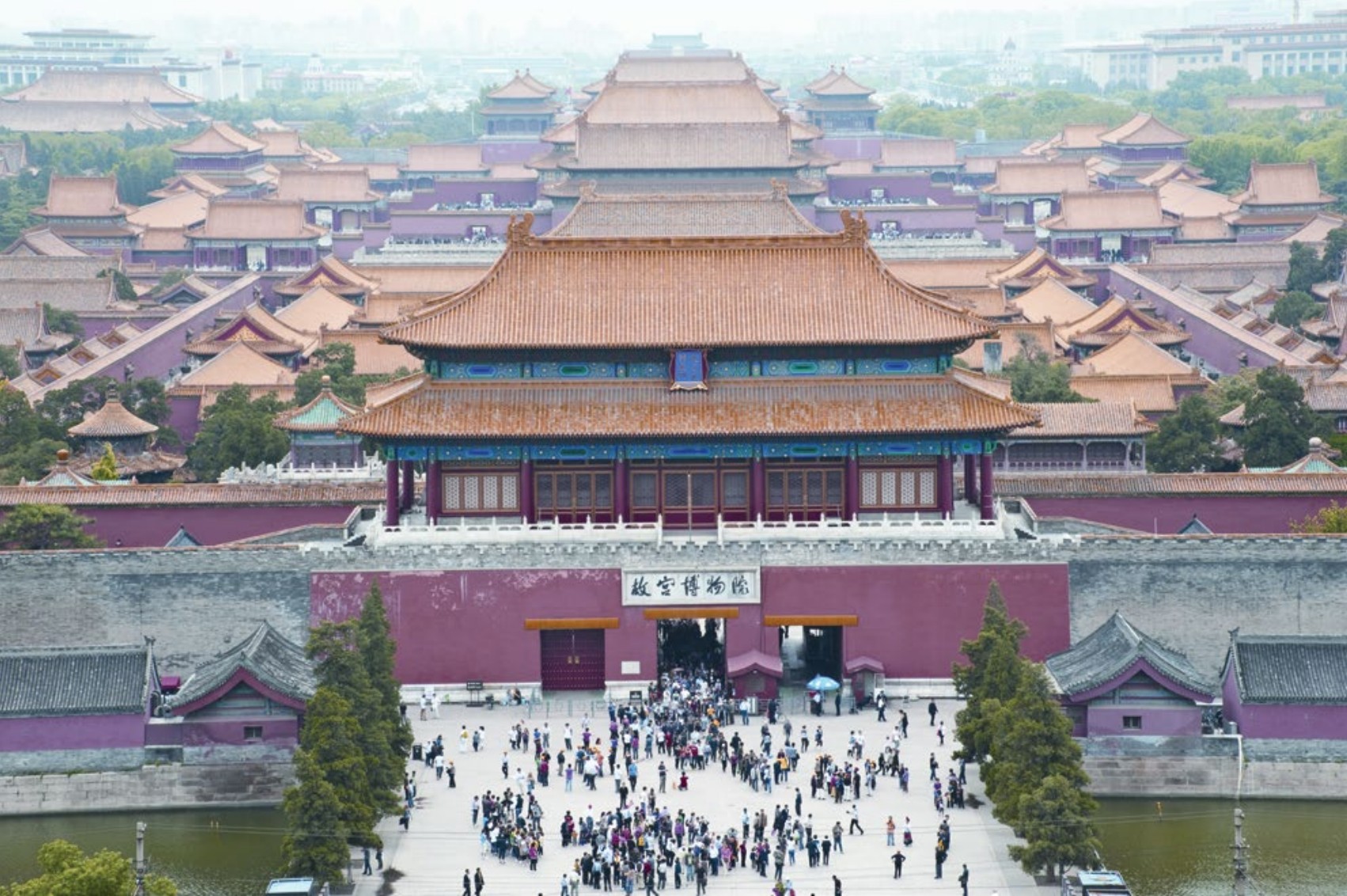
 Forbidden City © Atlantide Phototravel/Corbis
Forbidden City
Beijing, China. Ming Dynasty. 15th century C.E. and later. Stone masonry, marble, brick, wood, and ceramic tile.
Curator Note
"The center of the world. For 500 years, this was the home of the Emperor (the Son of Heaven). No commoner could enter. Designed as a series of gates and courtyards leading to the ultimate power center, it reinforces the hierarchy of the Chinese state and the cosmic order of the Emperor keeping the universe in balance."
Form
- Layout: Axial symmetry on a North-South axis (Feng Shui).
- Scale: 980 buildings, 178 acres, surrounded by a moat/wall.
- Color: Red walls (auspicious) and Yellow tiles (Imperial color).
- Architecture: Wooden post-and-beam construction with dougong brackets.
- Numerology: Dominance of the number 9 (emperor's number).
Function
- Imperial Palace: Home of the Emperor and his court.
- Administrative Center: Where state affairs were conducted.
- Ritual Stage: Setting for strict Confucian ceremonies.
- Microcosm: Modeled on the Purple Palace in heaven (Polaris).
- Separation: Isolated the Emperor from the population.
Content
- Hall of Supreme Harmony: The largest hall, containing the Dragon Throne.
- Outer Court: For state affairs (men only).
- Inner Court: Domestic sphere (Emperor, Empress, Consorts, Eunuchs).
- Meridian Gate: The massive main entrance.
- River of Golden Water: Flows through the courtyard (Feng Shui).
Context
- Ming Dynasty: Built by the Yongle Emperor moving the capital to Beijing (1406-1420).
- Qing Dynasty: Occupied and renovated by the Manchus later.
- Construction: required 1 million laborers and 100,000 artisans.
- Confucianism: The layout physically enforces social hierarchy.
- Modern usage: Now the Palace Museum (public can enter).