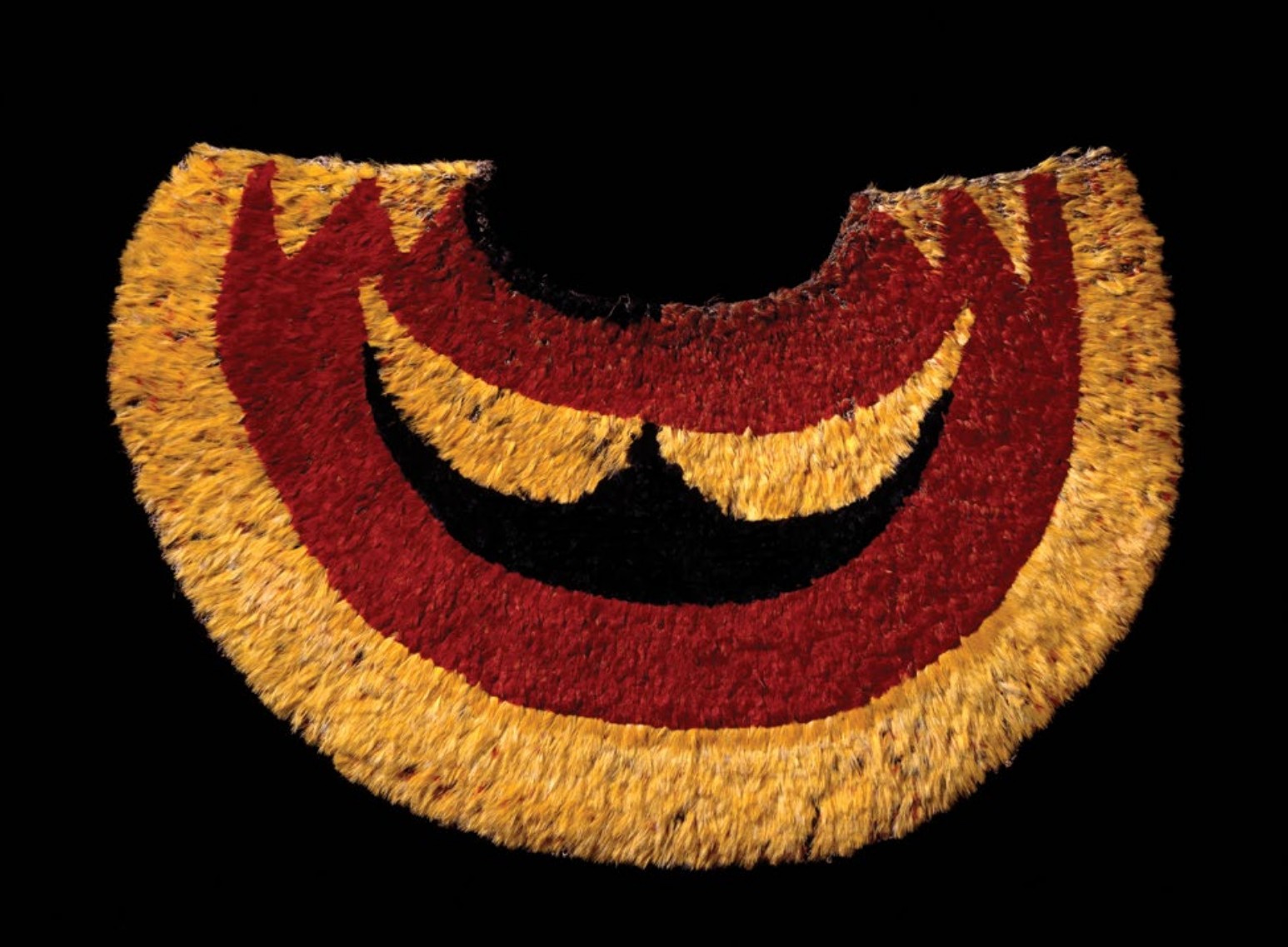
 'Ahu 'ula © The Trustees of the British Museum/Art Resource, NY
'Ahu 'ula (feather cape)
Hawaiian. Late 18th century C.E. Feathers and fiber.
Curator Note
"Armor made of flowers of the sky. In Hawaiian culture, the head was the most sacred part of the body, and feathers (from birds that fly high) held immense mana. This cape wasn't just for show—it offered spiritual protection in battle and signaled the divine rank of the chief (ali'i)."
Form
- Material: Olona fiber netting backing with thousands of exotic bird feathers.
- Colors: Red (royal/sacred) from 'I'iwi bird, Yellow (rare/precious) from 'O'o bird.
- Shape: Semi-circular/trapezoidal cape designed to cover the shoulders.
- Texture: Velvety, dense layering of feathers.
- Pattern: Bold geometric designs (crescents, triangles) specific to the lineage.
Function
- Regalia: Worn by high-ranking chiefs (ali'i) for ceremonies and battle.
- Spiritual Armor: Believed to protect the wearer's mana and deflect weapons.
- Gift: Often given to European explorers (like Captain Cook) as a sign of respect.
- Status Symbol: The scarcity of yellow feathers made them incredibly valuable.
- Tapu: The cape was tapu (sacred) and could only be worn by the specific chief.
Content
- Yellow Feathers: From the 'O'o bird (which had only a few yellow feathers), signifying immense wealth.
- Red Feathers: Associated with the gods and chiefs.
- Geometric motifs: Associated with specific gods or genealogical lines.
- Neckline: Closely fitted to protect the vulnerable back of the neck.
- Draping: Designed to swell and move, enhancing the chief's physical presence.
Context
- Mana: The spiritual power contained in the person and the object.
- Production: Chant and prayer were woven into the netting as it was made.
- Gender roles: Created by men (entrusted with the potential pollution of tapu).
- Ecological impact: Birds were often caught, plucked, and released (conservation).
- Contact: Many collected during early European voyages (Cook's 3rd voyage).