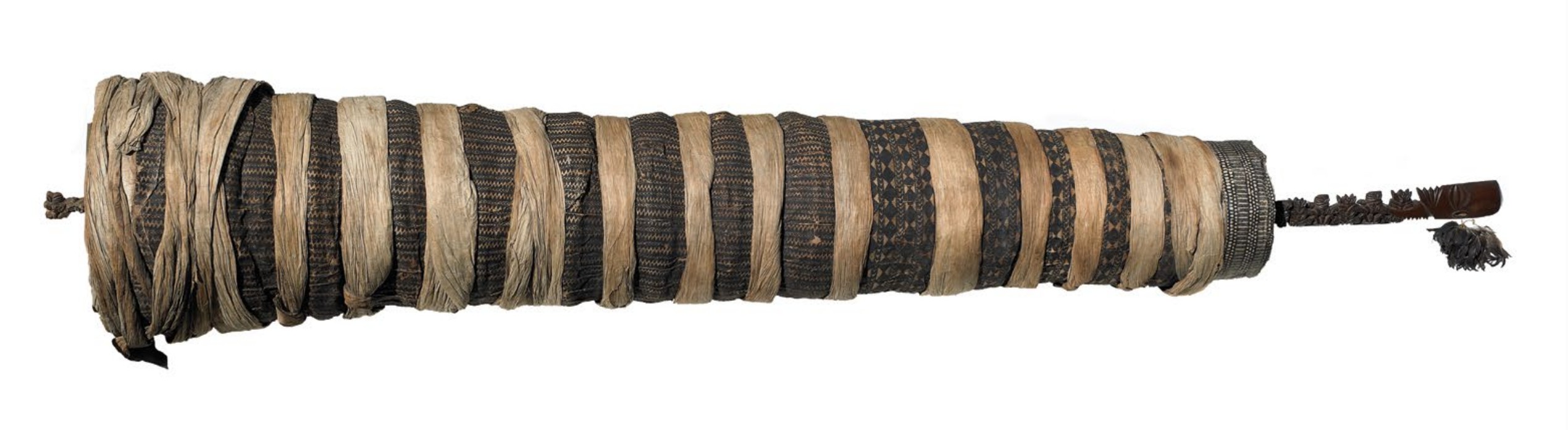
 Staff god © The Trustees of the British Museum
Staff god
Rarotonga, Cook Islands, central Polynesia. Late 18th to early 19th century C.E. Wood, tapa, fiber, and feather.
Curator Note
"Wrapped power. This large wooden staff, carved with stylized figures, was wrapped in endless layers of barkcloth (tapa). The wrapping wasn't just packaging—it contained and protected the deity's mana. Most were destroyed by missionaries who saw them as idols "obscene" in their imagery."
Form
- Format: Elongated wooden staff (up to 4 meters long) wrapped in tapa cloth.
- Upper Carving: Large stylized head with smaller figures carved on the neck.
- Lower Carving: Phallus (often cut off by missionaries) representing fertility.
- Central Shaft: The "body" consisting of the rolled/wrapped tapa mats.
- Material: Ironwood (very hard), barkcloth, red feathers, pearl shell.
Function
- Religious Vessel: Housed the spirit of the creator god (likely Tangaroa).
- Community relic: The wrapping process involved the whole community.
- Presentation: Carried and displayed during major rituals.
- Fertility: Explicitly linked to reproduction and the lineage of the tribe.
- Protection: The "wrapping" aspect protected the mana from dispersing.
Content
- Manava: The "soul" or "spirit" inside (red feathers/shells) placed within the wrapping.
- Profile figures: Alternating male and female figures (genealogy/ancestors).
- Tapa cloth: Made by women, representing the female element wrapping the male staff.
- Head: Represents the primary deity.
- Phallus: Represents the generative power (often removed).
Context
- Missionary era: London Missionary Society arrived in 1821.
- Destruction: Missionaries forced locals to burn them; this survivor was sent back to London.
- Gender dynamics: Men carved the hard wood; women made the soft cloth.
- Wrapping logic: In Polynesia, sacred objects are often wrapped to contain mana and protect the viewer.
- Rarotonga: The specific island style features the distinct large head/mouth.