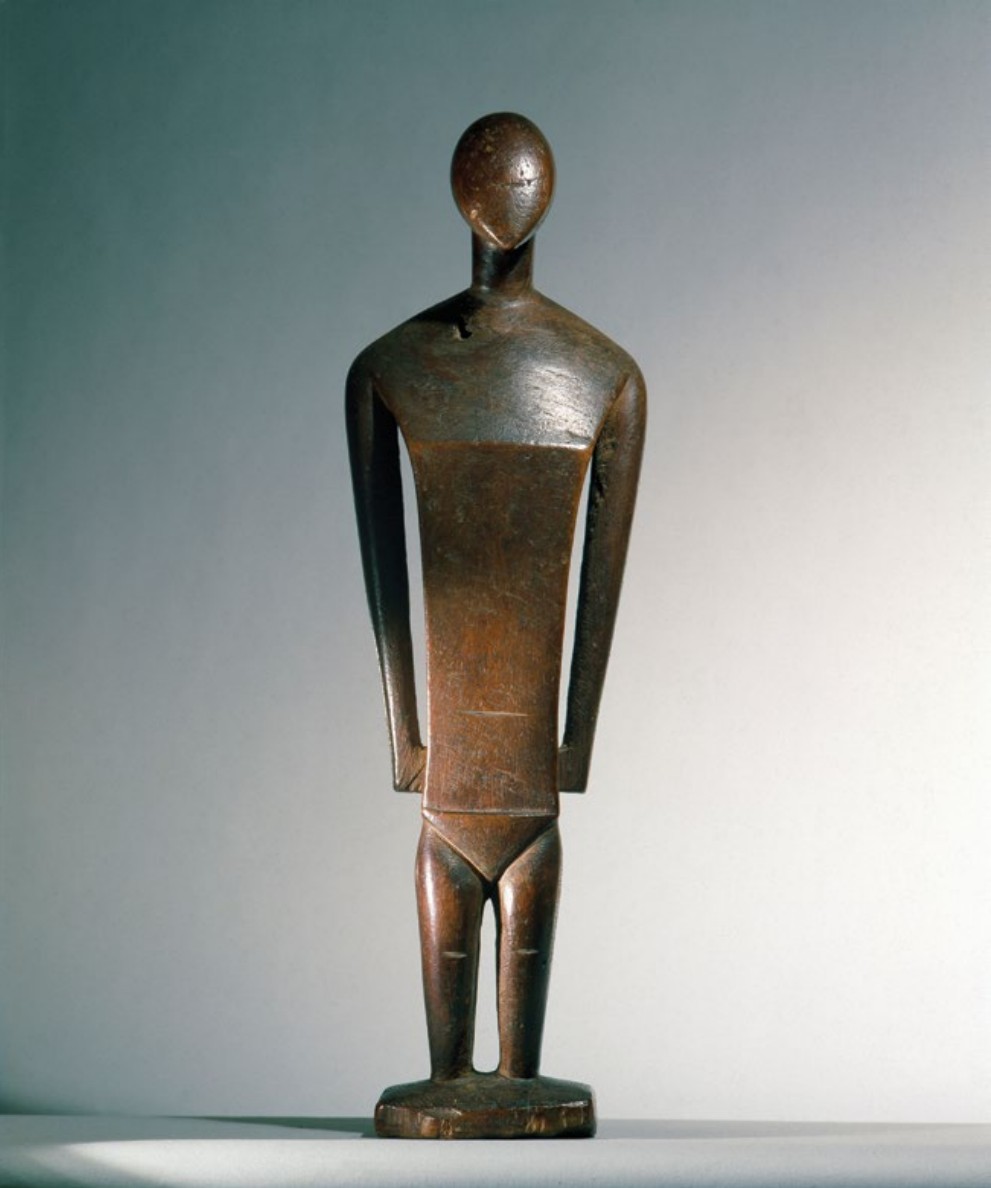
 Female deity © Werner Forman Archive/The Bridgeman Art Library
Female deity
Nukuoro, Micronesia. c. 18th to 19th century C.E. Wood.
Curator Note
"Abstract perfection. This sleek, minimalist figure looks incredibly modern (like Brancusi or Modigliani) but is a ritual object from a remote atoll. It represents a specific deity (tino aitu) and would have been dressed in clothes and flowers, not displayed nude as we see it today."
Form
- Style: Minimalist, abstract, geometric reduction of the human form.
- Surface: Smooth, polished wood (rubbed with pumice and oil).
- Proportions: Elongated torso, short legs, ovoid head with rudimentary chin.
- Details: No facial features, hands, or feet; marked pubic triangle.
- Material: Breadfruit wood (Artocarpus altilis).
Function
- Ritual Object: Resting place for a god or deified ancestor during ceremonies.
- Harvest Festival: Placed in the temple (amalau) during the Mataariki harvest festival.
- Offerings: Recipients of food, flowers, and mats.
- Community focus: Symbols of lineage and clan identity.
- Decoration: During use, they were wrapped/clothed (we view them "naked" now).
Content
- Deity (Tino Aitu): Represents a specific goddess (e.g., Ko Kawe).
- Postural Syntax: Standing tall, arms hanging free, flexed knees.
- Shoulders: Broad, squared-off shoulders tapering to arms.
- Pubic Area: Incised triangle indicates female gender clearly.
- Facial blankness: Allows for universal/abstract projection of divinity.
Context
- Nukuoro Atoll: A Polynesian outlier within Micronesia (Polynesian culture/DNA).
- Western Influence: Artists like Giacometti and Moore admired these for their "primitive" modernism.
- Scarcity: Only about 20 of these figures survive today.
- Missionary impact: Most were collected or destroyed as Christianity spread.
- Aesthetics: The Nukuoro value "masi" implies beauty through cleanliness/trimness.