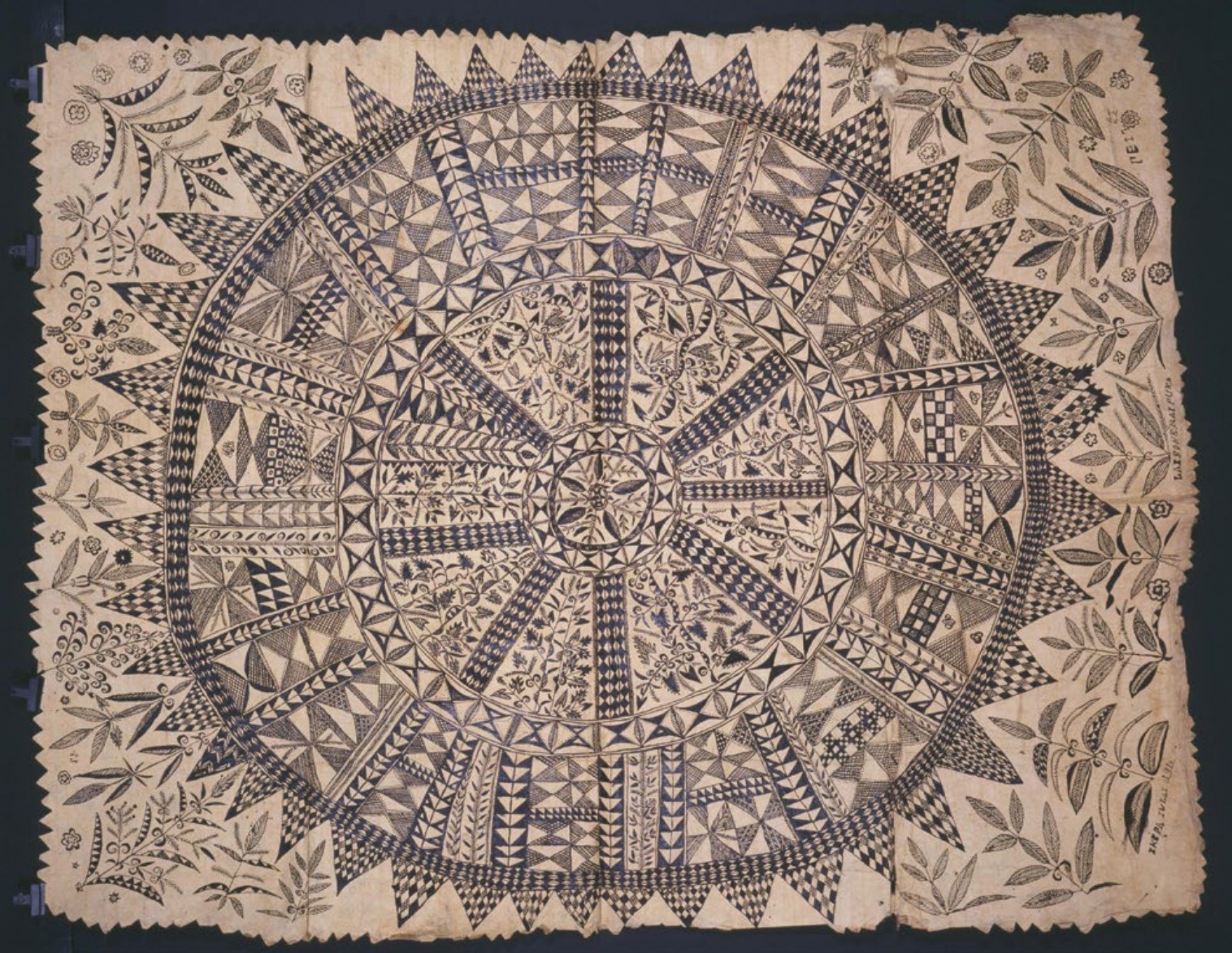
 Hiapo © Auckland War Memorial Museum/Pacific Collection 1948.34
Hiapo (tapa)
Niue. c. 1850–1900 C.E. Tapa or bark cloth, freehand painting.
Curator Note
"The fabric of society. Tapa cloth is the "textile" of the Pacific, made by beating tree bark. In Niue, they developed a unique style called Hiapo, introducing freehand drawing of plants and even people, diverging from the strict geometric patterns of other islands."
Form
- Material: Inner bark of the paper mulberry tree (Broussonetia papyrifera).
- Technique: Bark is harvested, soaked, and beaten with a wooden mallet (ike) into sheets.
- Decoration: Freehand painting using rubbings and stencils.
- Patterns: Spirals, concentric circles, and naturalistic motifs.
- Composition: Often radial or grid-like, filling the space.
Function
- Clothing: Worn as skirts/ponchos for ceremonies.
- Bedding/Dividers: Used as blankets or room dividers.
- Gift/Exchange: Vital for weddings, funerals, and sealing alliances.
- Wrapping: Sacred wrapping for bodies or deity figures (tapu).
- Identity: Distinct Niuean style asserts local identity.
Content
- Vegetal motifs: Vines, leaves, and flowers (introduced after European contact?).
- Human figures: Sometimes includes small depictions of people (rare in tapa).
- Text: Some hiapo include writing (names/dates).
- Spirals: Common energetic motif.
- Complexity: The more complex the design, the higher the prestige.
Context
- Women's Art: Tapa making is traditionally a female sphere (men carve wood).
- Niue ("Savage Island"): Cook was chased off; missionaries arrived later.
- Innovation: Hiapo style emerged in the late 19th c., possibly influenced by Samoan missionaries.
- Collectives: Women worked in groups to beat the large cloths.
- Decline and Revival: The art form declined with imported cotton but has been revived.