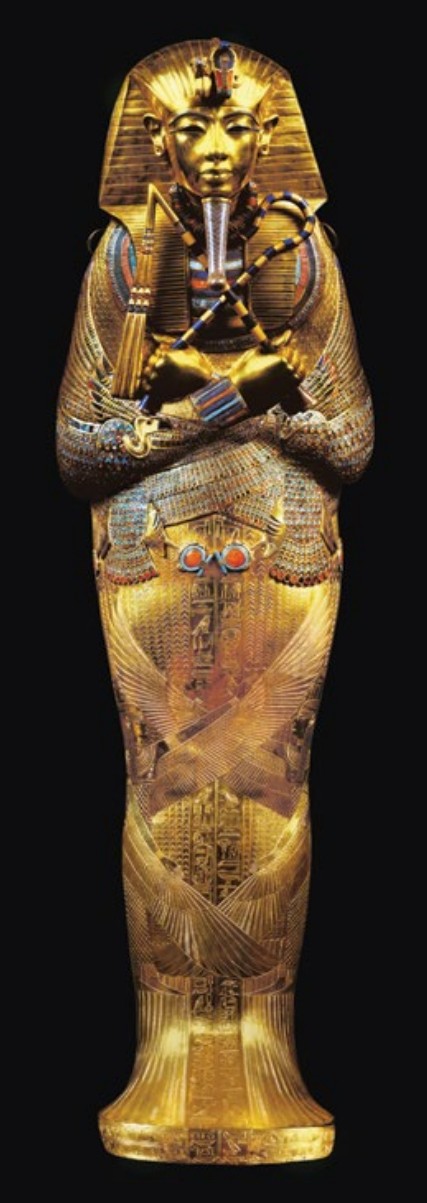
 Tutankhamun’s innermost coffin © Sandra Vannini/Corbis
Tutankhamun’s Tomb, Innermost Coffin
New Kingdom, 18th Dynasty. c. 1323 B.C.E. Gold with inlay of enamel and semiprecious stones.
Curator Note
"Discovered intact by Howard Carter in 1922, this solid gold coffin (243 lbs) became the icon of Ancient Egypt. It was hidden so well that it escaped the tomb robbers who plundered nearly every other royal grave."
Form
- Solid gold coffin (the innermost of three), weighing 243 pounds (beaten gold).
- Inlaid with enamel and semi-precious stones: Lapis Lazuli (blue), Turquoise, Carnelian (red).
- Idealized portrait of the young king as a god.
- Repoussé technique used to shape the gold from the inside.
- Cloisonné technique used for the inlays.
Function
- To protect and preserve the mummified body of the Pharaoh.
- To transform the earthly king into a divine being (gold skin = flesh of the gods).
- The final container in a Russian-doll-like series of sarcophagi and shrines.
- Ensured the king's safe passage and rebirth in the afterlife.
- Displayed the immense wealth and power of the 18th Dynasty.
Content
- Tutankhamun depicted in the Nemes headdress with the Ureaus (cobra) and Nekhbet (vulture).
- Arms crossed over the chest holding the Crook and Flail, symbols of Osiris (rule and agriculture).
- Wings of goddesses Isis and Nephthys embrace the torso for protection.
- False beard of kingship.
- Hieroglyphic prayers and spells from the Book of the Dead.
Context
- Discovered intact by Howard Carter in 1922 in the Valley of the Kings.
- Tutankhamun was a minor pharaoh who died young (19) but restored the old religion after Akhenaten.
- The tomb was hidden by rubble from a later tomb, saving it from ancient grave robbers.
- The immense wealth of this "minor" king suggests the lost treasures of great pharaohs like Ramses II were unimaginable.
- Sparked "Egyptomania" in the 1920s and influenced Art Deco design.