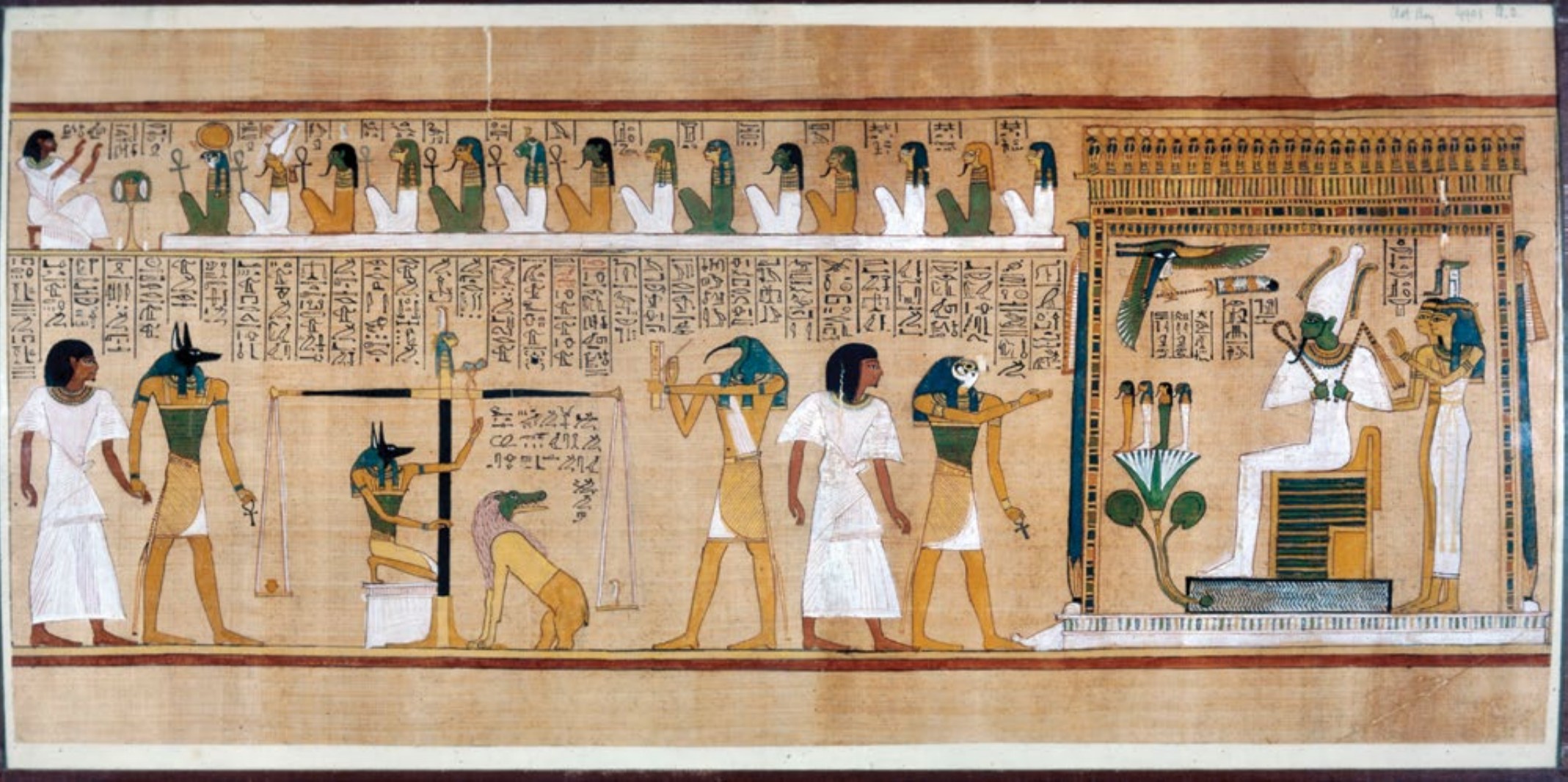
 Last judgment of Hu-Nefer © The Trustees of the British Museum/Art Resource, NY
Last Judgment of Hu-Nefer
New Kingdom, 19th Dynasty. c. 1275 B.C.E. Painted papyrus scroll.
Curator Note
"A "cheat sheet" for the afterlife. This scroll was buried with the royal scribe Hu-Nefer to help him pass the Weighing of the Heart ceremony and enter eternal paradise."
Form
- Painted papyrus scroll (a type of paper made from reeds).
- Continuous narrative: The main character (Hu-Nefer) appears multiple times in the same scene.
- Organized with registers and ground lines.
- Text (hieroglyphs) and image are integrated to tell the story.
- Figures are stiff, angular, and composite (typical of Egyptian pictorial style).
Function
- A "Book of the Dead" (guidebook) buried with the deceased.
- Provided spells and instructions to help the soul navigate the trials of the underworld.
- Ensured the deceased passed the Weighing of the Heart judgment.
- Guaranteed eternal life in the Field of Reeds (paradise).
- Proved the piety and preparation of the royal scribe Hu-Nefer.
Content
- Top register: Hu-Nefer pleads his case before the 42 judges of the dead.
- Main scene: Anubis leads Hu-Nefer to the scale.
- Weighing of the Heart: The heart (seat of soul) is weighed against the Feather of Maat (truth).
- Ammit (the hybrid "Eater of the Dead") waits to devour the heart if it is heavy with sin.
- Thoth (ibis-headed scribe) records the result; Osiris welcomes Hu-Nefer to the afterlife.
Context
- New Kingdom, 19th Dynasty (c. 1275 B.C.E.).
- Found in the tomb of Hu-Nefer, a "Royal Scribe" (high official) in Thebes.
- Reflects the "democratization of the afterlife"—formerly only for kings, now accessible to elites.
- Demonstrates the Egyptian belief in a moral judgment after death.
- Replaced the earlier Pyramid Texts and Coffin Texts.