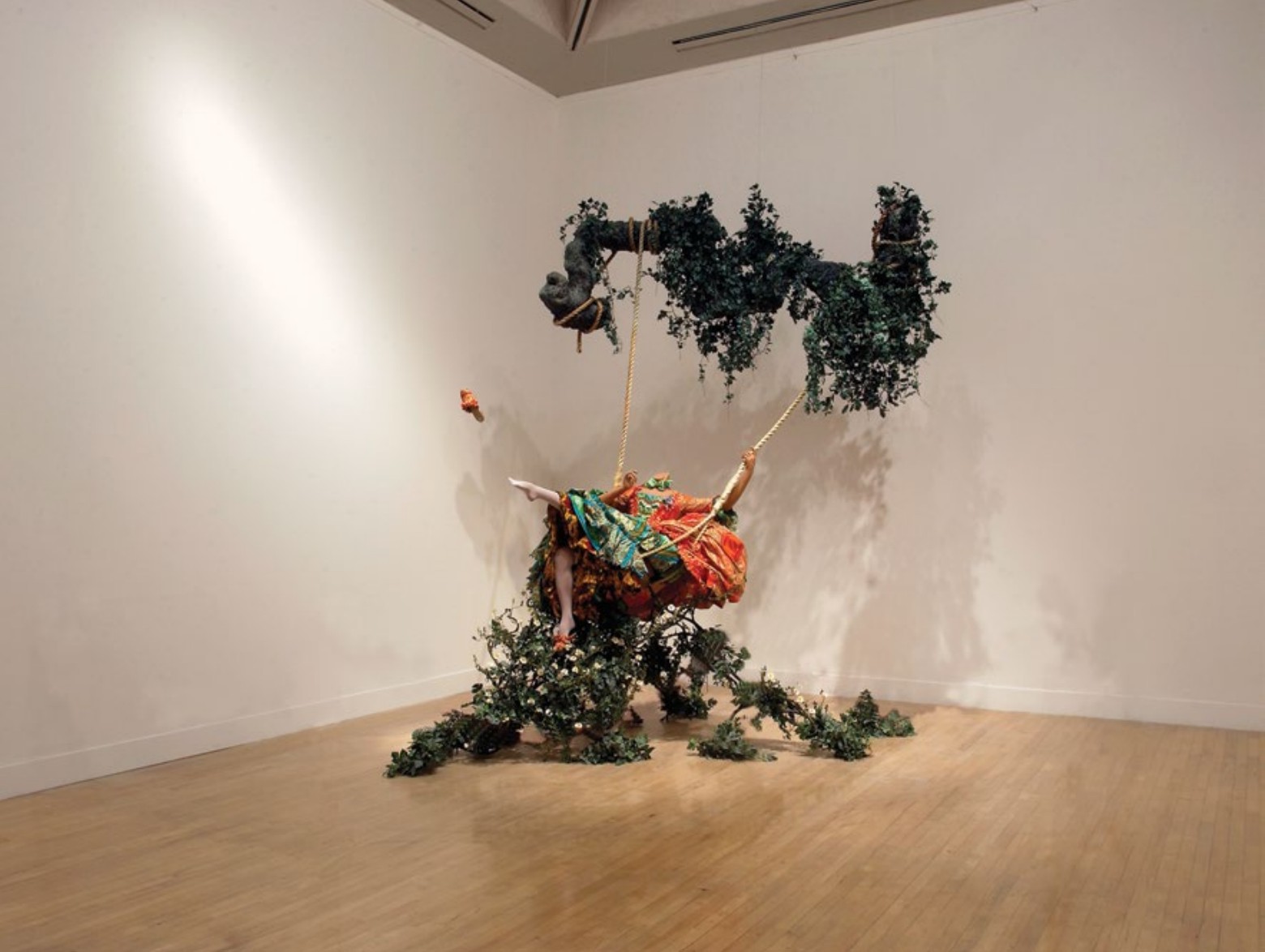
 The Swing (after Fragonard) © 2013 Tate, London
The Swing (after Fragonard)
Yinka Shonibare by MBE. 2001 C.E. Mixed-media installation
Curator Note
"A 3D recreation of Fragonard’s Rococo painting "The Swing," but headless and dressed in "African" Dutch wax fabric. Shonibare, a British-Nigerian artist, uses the headless mannequin to evoke the French Revolution (guillotine) and the mindless indulgence of the aristocracy. The fabric, assumed to be African, is actually a product of Dutch colonialism, highlighting the complexity of global trade and identity."
Form
- Three-dimensional installation mimicking the composition of the famous painting.
- Life-sized headless mannequin on a swing suspended from the ceiling.
- Mannequin dressed in Dutch wax printed cotton textile.
- Surrounded by artificial foliage to recreate the garden setting.
- Dynamic pose: shoe flying off in mid-air.
Function
- To explore the complex origins of "African" identity and globalization.
- To critique class hierarchy and the leisure of the wealthy.
- To connect the excess of the Rococo period with modern inequality.
- To question the authenticity of cultural symbols (the fabric).
- To humorously decapitate the history of Western art.
Content
- Dutch wax fabric: Indonesian batik design, made in Holland, sold to West Africa.
- Headlessness: reference to the French Revolution beheading the aristocracy.
- The Swing: symbol of frivolous erotica and aristocratic privilege.
- The "African" dress on a European figure subverts expectations.
- A warning about the sustainability of extreme wealth/indulgence.
Context
- Shonibare calls himself a "post-colonial hybrid" (British-Nigerian).
- Dutch wax fabric is a central motif in his work, representing colonial trade routes.
- Fragonard’s original painting (1767) is an icon of the Ancien Régime.
- Works addresses race, class, and the legacy of imperialism.
- Uses "MBE" (Member of the British Empire) ironically in his name.