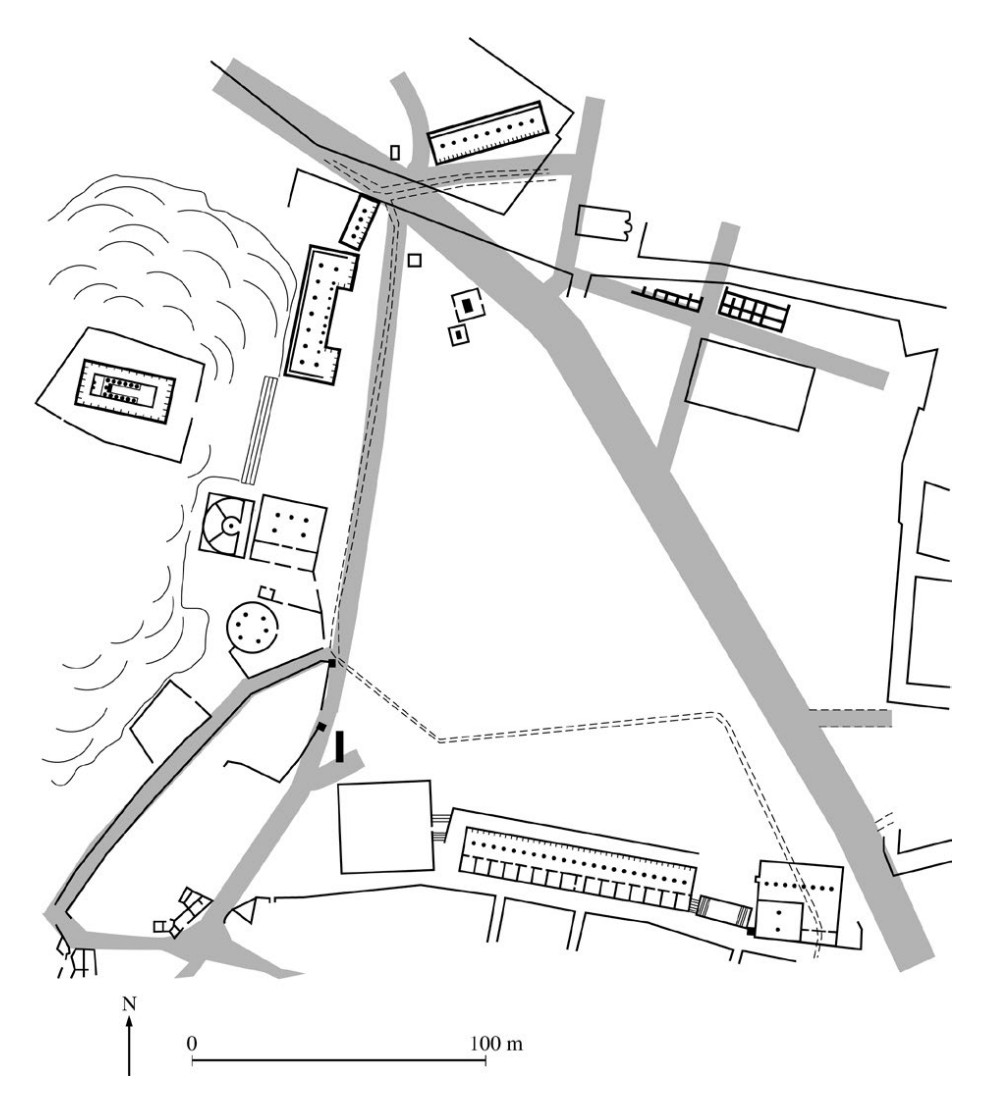
 Athenian agora site plan
Athenian Agora
Archaic through Hellenistic Greek. 600 B.C.E.–150 C.E. Plan.
Curator Note
"The birthplace of democracy. This wasn't just a market; it was the civic heart of Athens where Socrates debated, citizens voted (sometimes with pottery shards for ostracism), and the Panathenaic procession began."
Form
- Open, organic layout at the base of the Acropolis (not a rigid grid like Roman forums).
- Evolved over centuries from the Archaic to the Roman periods.
- Defined by Stoas (long covered colonnades) providing shade and meeting space.
- Panathenaic Way acts as the main diagonal spine cutting through the vast plaza.
- Mix of religious, secular, commercial, and governmental buildings.
Function
- The civic, commercial, and political heart of Athens.
- Marketplace (buying/selling goods).
- Birthplace of democracy: Location of the Bouleuterion (Council) and voting.
- Religious center: Altar of the Twelve Gods.
- Social hub: Where Socrates debated and citizens gathered for discourse.
Content
- Panathenaic Way: Ceremonial path for the procession to the Parthenon.
- Stoa of Attalos: Massive two-story shopping mall/office.
- Tholos: Round temple serving as the executive office/dining hall for senators.
- Temple of Hephaestus: Well-preserved Doric temple overlooking the market.
- Boundary stones marked the sacred limits of the Agora.
Context
- Athens in the 5th Century B.C.E. (Golden Age of Pericles).
- Direct democracy required active citizen participation (male citizens only).
- Ostracism votes (using pottery shards) were held here to banish dangerous politicians.
- Contrasts with the Acropolis: Agora is the space of the people (demos), Acropolis is the space of the gods.
- Invaded and destroyed multiple times (Persians, Romans, Herulians).