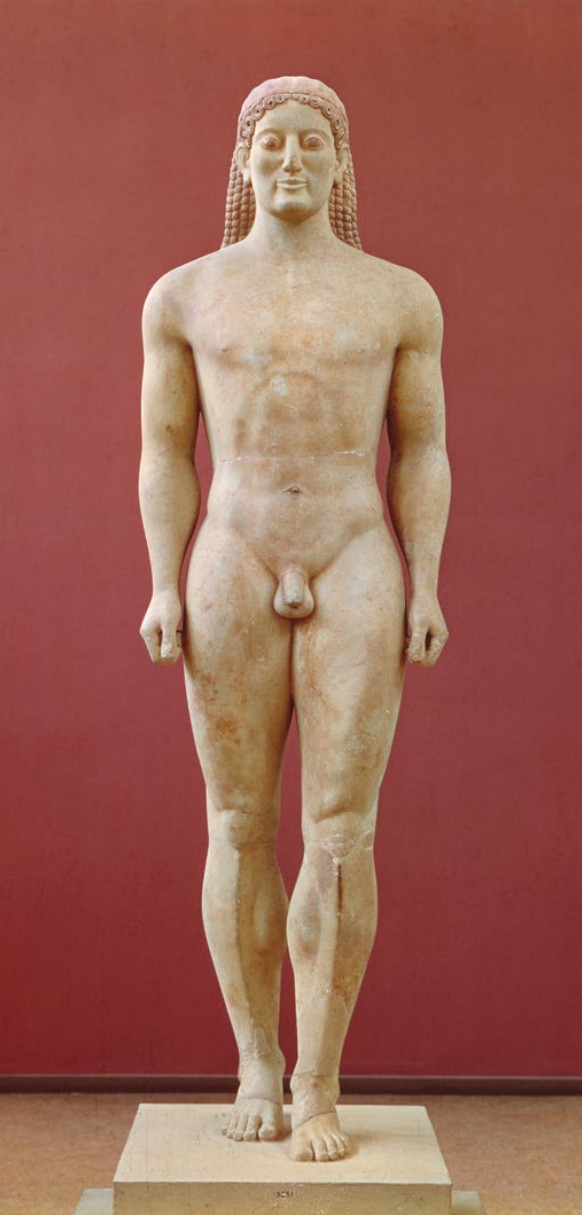
 Anavysos Kouros © Scala/Art Resource, NY
Anavysos Kouros
Archaic Greek. c. 530 B.C.E. Marble with remnants of paint.
Curator Note
"Looking into the face of a fallen soldier. The inscription reads: "Stay and mourn at the tomb of dead Kroisos, whom raging Ares destroyed one day as he fought in the foremost ranks.""
Form
- Free-standing marble sculpture (sculpture in the round).
- Archaic Smile: A stylized convention to indicate life/vitality, not emotion.
- Egyptian Stance: Rigid, frontal pose, left foot forward, arms at sides, fists clenched.
- Greater naturalism than earlier Kouroi: Rounded hips, defined muscles, integrated wig-like hair.
- Remnants of red encaustic paint on the hair and headband.
Function
- Grave marker (funerary statue) for a fallen young soldier.
- Replaced the huge geometric vases of the previous period as grave markers.
- Commemorative monument focusing on the ideal rather than a specific portrait.
- Demonstrates the wealth and status of the family who commissioned it.
- Embodied the concept of "kalokagathia" (beautiful and good).
Content
- Nude male youth (Kouros), representing the ideal Greek man.
- Inscription on the base: "Stay and mourn at the tomb of dead Kroisos, whom raging Ares destroyed one day as he fought in the foremost ranks."
- Long braided hair and headband.
- Idealized, athletic physique representing "Arete" (excellence).
- Lack of distinct personality; represents Youth itself.
Context
- Late Archaic Period (c. 530 B.C.E.), showing the transition towards Classical realism.
- Found at Anavysos (rural Attica), recovering from an illegal excavation.
- Contrast with Egyptian Sculpture: The Greek figure is nude (humanism) and free from the stone block (independence).
- The "Archaic Smile" persists despite the tragic context of death in war.
- Reflects the aristocratic culture of Archaic Athens before democracy fully took hold.