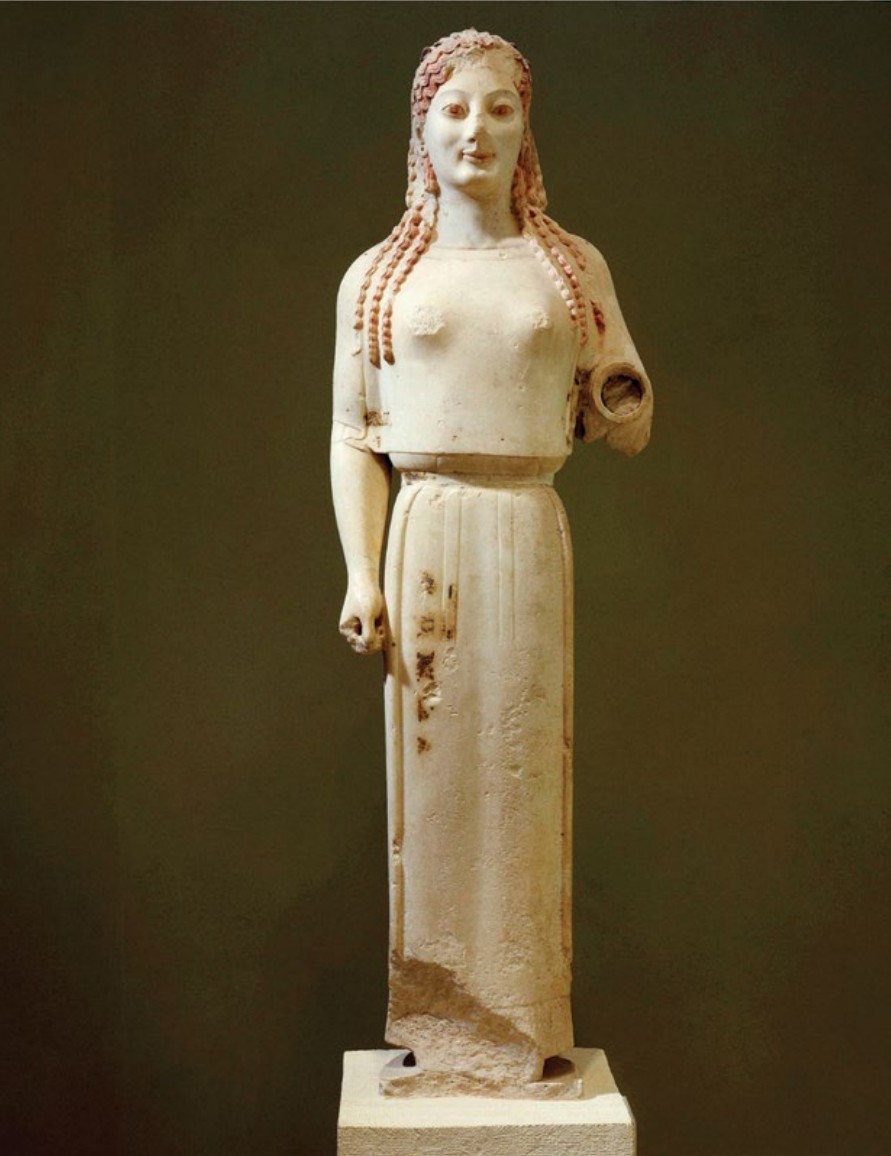
 Peplos Kore © Gianni Dagli Orti/The Art Archive at Art Resource, NY
Peplos Kore from the Acropolis
Archaic Greek. c. 530 B.C.E. Marble, painted details.
Curator Note
"She was buried for 2,000 years after the Persians sacked the Acropolis in 480 B.C.E., preserving her original paint. Recent research suggests she isn't just a maiden, but likely the goddess Artemis."
Form
- Parian marble with substantial remnants of encaustic (wax-based) paint.
- Kore (Maiden): Clothed female figure, counterpart to the nude male Kouros.
- Column-like, rigid stance with little sense of movement.
- Archaic Smile: Indicates life and transcendence.
- Soft modeling of the female form beneath the heavy drapery.
Function
- Votive offering to the goddess Athena on the Acropolis.
- Likely a representation of a goddess (Artemis or Athena) rather than a human maiden.
- Used to garner favor from the divine or give thanks.
- Stood outside the temple as a permanent worshipper.
- Demonstrates the piety and wealth of the donor.
Content
- Dressed in a Peplos (ancient woolen robe) over a chiton.
- Holes in the head suggest she originally wore a metal diadem/crown.
- Left arm (heroic conceptual restoration) likely held a bow or arrows, identifying her as Artemis.
- Painted patterns on the dress (animals, geometric designs) visible under special light.
- Red hair and elaborate earrings.
Context
- Created c. 530 B.C.E. (Archaic Period).
- Buried in the "Persian Debris" after the Persians sacked the Acropolis in 480 B.C.E.
- This accidental burial preserved the paint, correcting the misconception that Greek art was pure white.
- Women in Archaic/Classical Greek art were almost always clothed, reflecting patriarchal social norms.
- Recent research challenges the generic "maiden" title, elevating her to a deity.