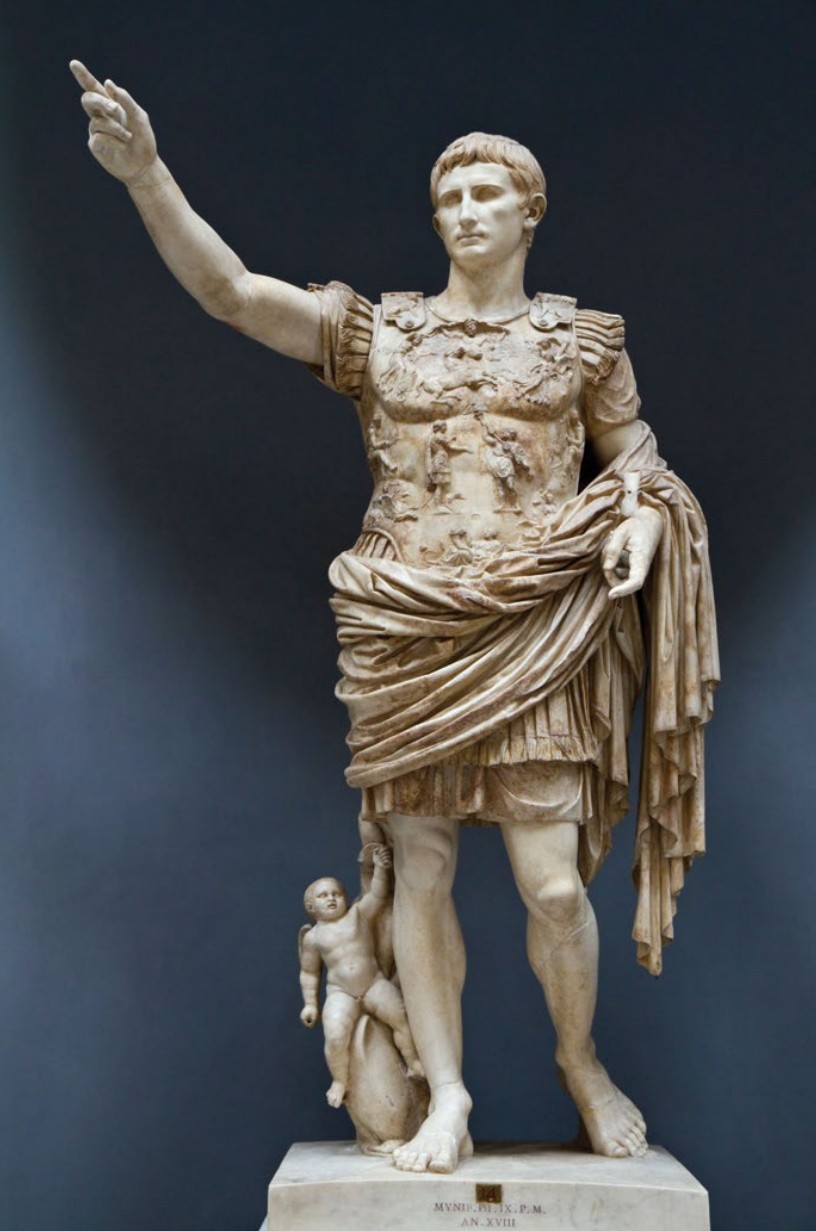
 Augustus of Prima Porta © Erin Babnik/Alamy
Augustus of Prima Porta
Imperial Roman. Early first century C.E. Marble.
Curator Note
"Political propaganda at its finest. Augustus is idealized as a perpetually young god-king, wearing armor that depicts his diplomatic victory over the Parthians, ushering in the Pax Romana."
Form
- Free-standing marble sculpture, over life-size (6'8").
- Idealized Naturalism: Combines the Greek Doryphoros body with a Roman portrait head.
- Contrapposto pose creates a sense of movement and command.
- Adlocutio gesture: Right arm raised in the pose of an orator addressing troops.
- Originally painted (traces of red, blue, gold found).
Function
- Political Propaganda: Distributes the Emperor's image and message across the empire.
- Commemorates a diplomatic victory (return of standards) over the Parthians.
- Establishes Augustus's divine lineage (connection to Venus).
- Presents the Emperor as eternally young, powerful, and god-like.
- Placed in the villa of his wife Livia to honor him.
Content
- Augustus dressed as an Imperator (General) in ceremonial armor.
- Breastplate (Cuirass) scenes: Parthian returning a standard, Sky God (Caelus), Earth Goddess (Tellus) = Cosmic peace.
- Cupid riding a dolphin at his feet: Symbolizes descent from Venus (via Aeneas) and naval victory (Actium).
- Barefoot: Normally reserved for gods, implying his divinity (or deceased status).
- Distinctive hair (comma-shaped locks) makes him recognizable.
Context
- Early Imperial Rome (Early 1st Century C.E.): The beginning of the Pax Romana.
- Augustus (Octavian) ended the Civil Wars and became the first Emperor.
- Consciously revived Greek Classical style (Golden Age) to associate Rome with Periclean Athens.
- Propaganda was essential to hold together the vast, diverse empire.
- Found in the Villa of Livia at Prima Porta.