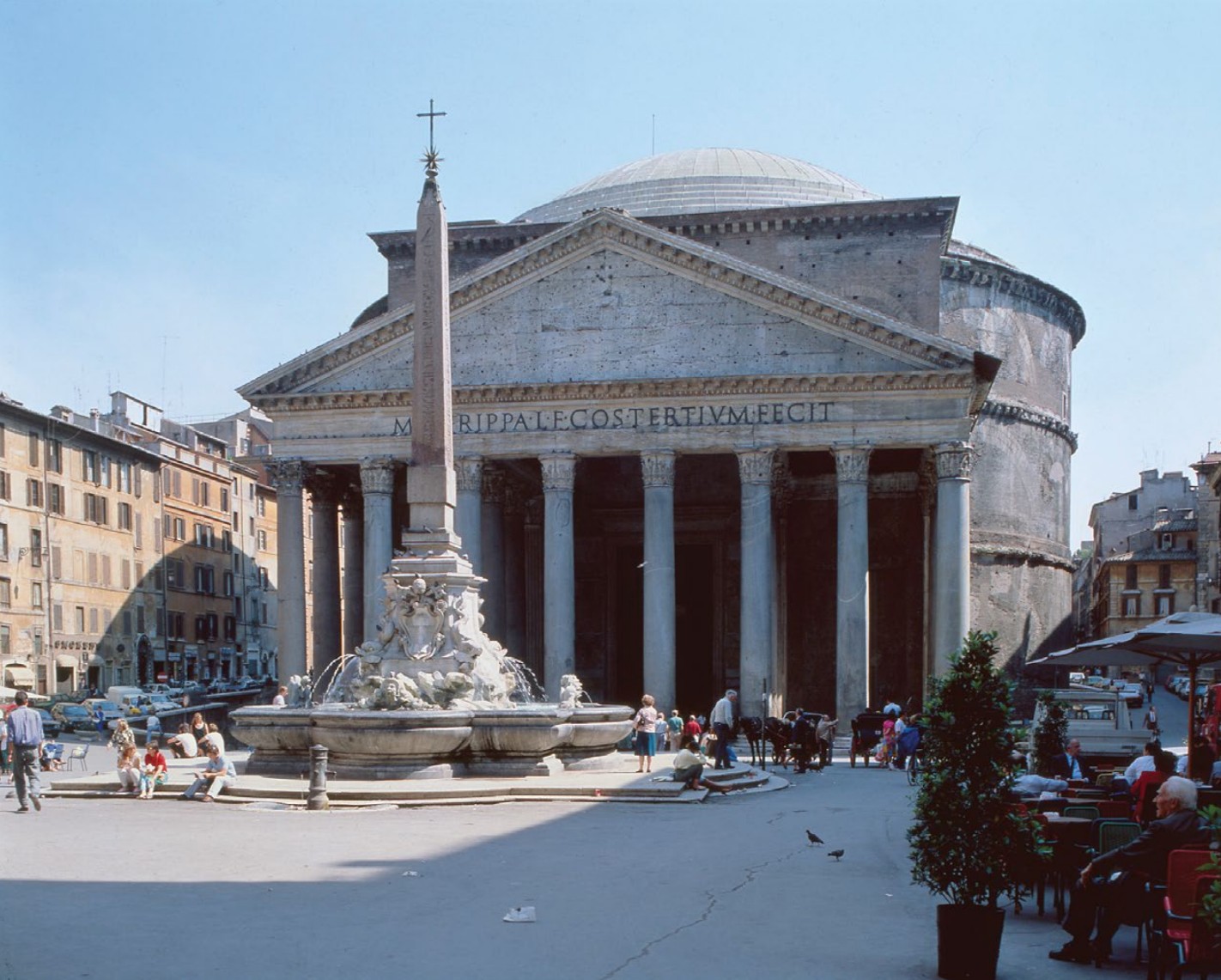
 Pantheon © Scala/Art Resource, NY
Pantheon
Imperial Roman. 118–125 C.E. Concrete with stone facing.
Curator Note
"The Temple of All Gods. Its unreinforced concrete dome is still the largest in the world today. The oculus acts as a spotlight, tracking the sun across the interior like a cosmic clock."
Form
- Rotunda (round drum) capped by a massive hemispherical concrete dome.
- Portico: Classical Greek porch with Corinthian columns of Egyptian granite.
- Oculus: 29-foot wide circular opening at the apex of the dome.
- Coffered Ceiling: Sunken panels in the dome reduce weight and add decoration.
- Geometric Perfection: The interior space is a sphere (height = diameter = 142 feet).
Function
- Temple dedicated to "All Gods" (Pan-Theos).
- Imperial Audience Hall: Used by Emperor Hadrian to hold court.
- Sundial/Cosmic Clock: The beam of light from the oculus moves across the room.
- Symbol of the universe and the Emperor's control over it.
- Christian Church (since 609 C.E.), ensuring its preservation.
Content
- Niches in the walls originally held statues of the planetary gods.
- Floor geometric pattern maintains the circle-and-square motif.
- The oculus connects the earthly temple directly to the heavens.
- Thick walls (20 feet) contain relieving arches to support the dome.
- Inscription honors Marcus Agrippa (Augustus's general), misleading historians for centuries.
Context
- Built by Emperor Hadrian (c. 118–125 C.E.), a lover of architecture.
- Revolutionary use of concrete (recipe changed as it went up, pumice at top).
- The largest unreinforced concrete dome in the world to this day.
- Symbolizes the stability, order, and permanence of the Roman Empire.
- Influenced virtually every dome built since (St. Peter's, US Capitol, Brunelleschi).