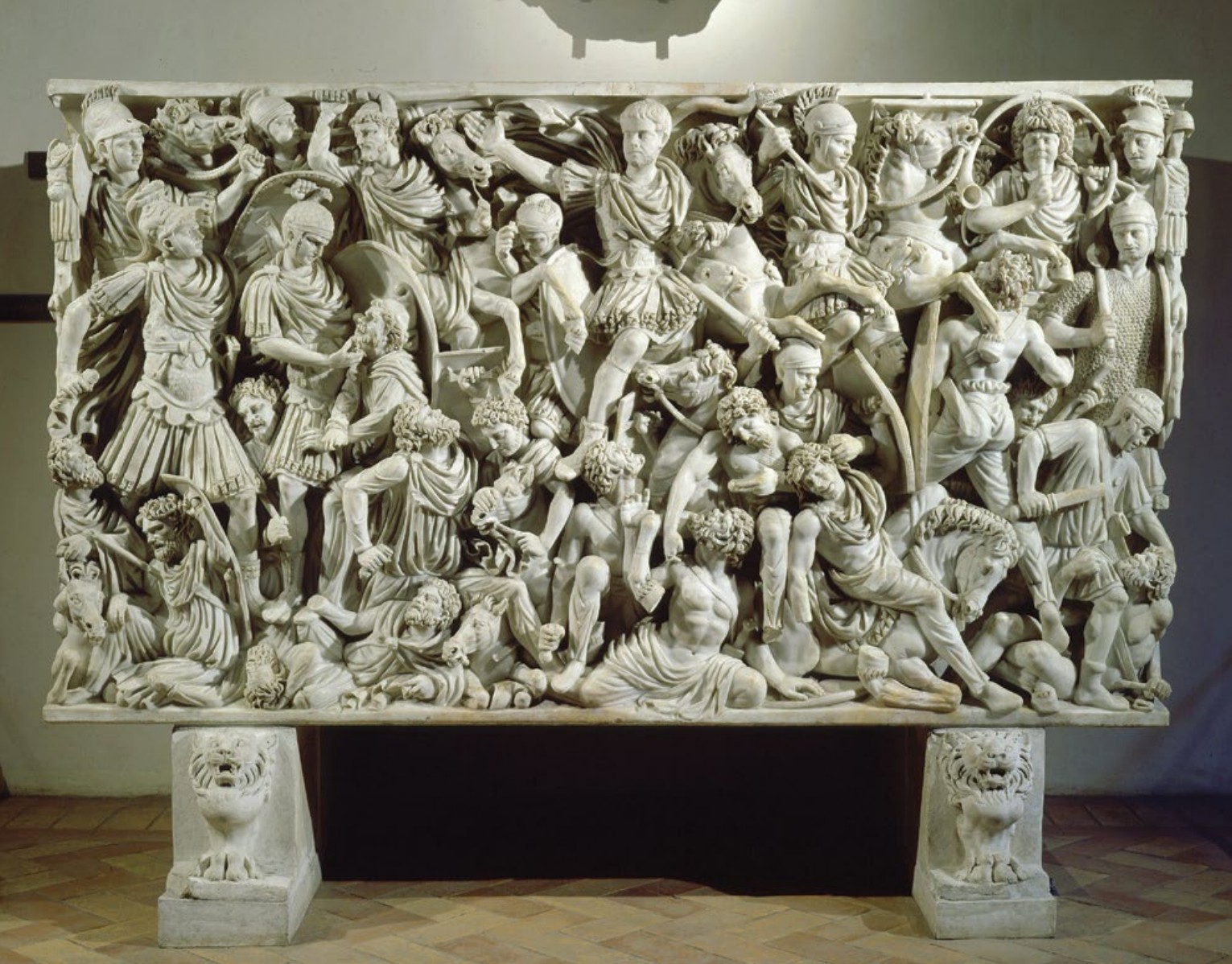
 Ludovisi Battle Sarcophagus © Gianni Dagli Orti/The Art Archive at Art Resource, NY
Ludovisi Battle Sarcophagus
Late Imperial Roman. c. 250 C.E. Marble.
Curator Note
"Chaos over order. Unlike the classical Parthenon friezes, this relief is a writhing mass of figures with no clear ground line, reflecting the instability and anxiety of the crumbling Roman Empire."
Form
- White marble sarcophagus carved in extremely high relief.
- Horror Vacui (Fear of Empty Space): The surface is completely packed with figures.
- Anti-Classical composition: No ground line, no perspective, chaotic piling of bodies.
- Deep drill work creates strong contrasts of light and dark (motion/texture).
- Disproportionate figures: Heads are larger, bodies are stubby (move away from anatomical correctness).
Function
- Funerary container for inhumation (burial), replacing cremation.
- Commemorates the military victories and status of the deceased (likely General Hostilianus?).
- Expresses the chaos and violence of the time period.
- Assures the deceased of triumph over death (symbolized by the hero).
Content
- Battle scene between Romans (heroic, noble, smooth-faced) and Goths (Barbarians, bearded, caricatured).
- Central Hero: A young general on horseback, arm raised, looking calm and detached (transcendent).
- X mark on the general's forehead may indicate initiation into the Cult of Mithras.
- Faces of the barbarians are expressive (pain, fear) while Romans are stern.
- Figures at the bottom are smaller, crushed by the weight of the battle.
Context
- Late Imperial Rome (c. 250 C.E.): "Crisis of the Third Century" (civil war, plague, invasion).
- Shift in Roman religion: Rise of mystery cults (Mithras, Christianity) promising afterlife.
- Shift in Art: Moving away from Greek realism towards Medieval symbolism and abstraction.
- Found near the Porta Tiburtina in Rome.
- Reflects the instability of the empire—battle is everywhere, order is lost.