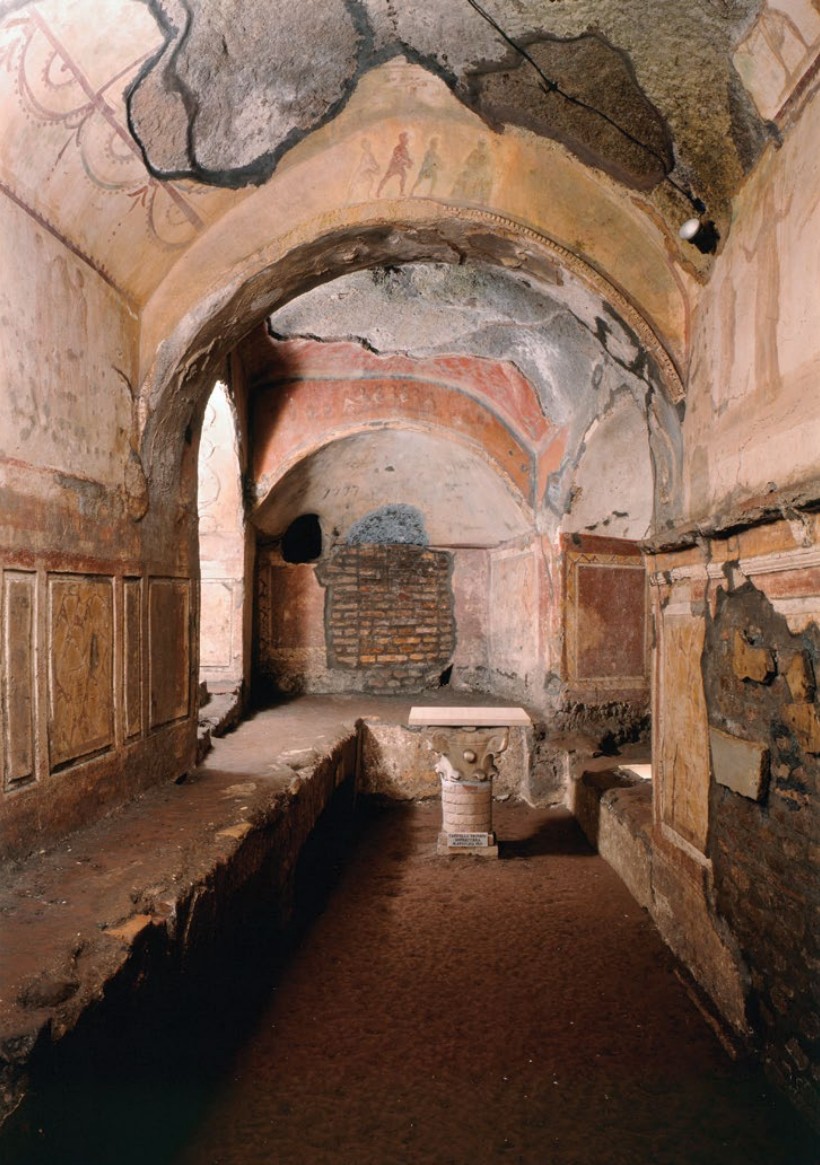
 Greek Chapel © Scala/Art Resource, NY
Catacomb of Priscilla
Rome, Italy. Late Antique Europe. c. 200–400 C.E. Excavated tufa and fresco.
Curator Note
"An underground burial chamber (hypogeum) used by early Christians for burial and secret worship during times of persecution. It contains some of the earliest known Christian frescoes, including the "Good Shepherd" and the "Orant" figure, adapting Roman artistic style (paleochristian) to express new Christian beliefs."
Form
- Excavated from tufa (volcanic rock).
- Narrow passageways (loculi) stacked on top of each other.
- Frescoes are sketchy, impressionistic (Roman style).
- Simplicity of figures; focus on symbolism not realism.
- Use of lunettes (semicircular wall sections) for images.
Function
- Burial place for members of the Priscilla family and Christian community.
- Place of worship and funeral feasts (refrigerium).
- To express hope for salvation and resurrection.
- To hide Christian practice during persecution.
- Contains remains of an estimated 40,000 Christians.
Content
- The Good Shepherd: Christ as a humble shepherd (syncretism with Apollo/Hermes).
- The Orant: A woman in a veil with hands raised in prayer (soul in peace).
- Old Testament scenes (Jonah, Daniel) prefiguring Christ.
- Greek Chapel: decorated in Pompeiian style.
- Christian symbols: anchor (hope), fish (Christ).
Context
- Christians were a persecuted minority in Rome.
- Burial was preferred over cremation (belief in bodily resurrection).
- Located on the Via Salaria, outside the city walls.
- Named after the donor of the land, Priscilla.
- Marks the transition from Roman to Early Christian art.