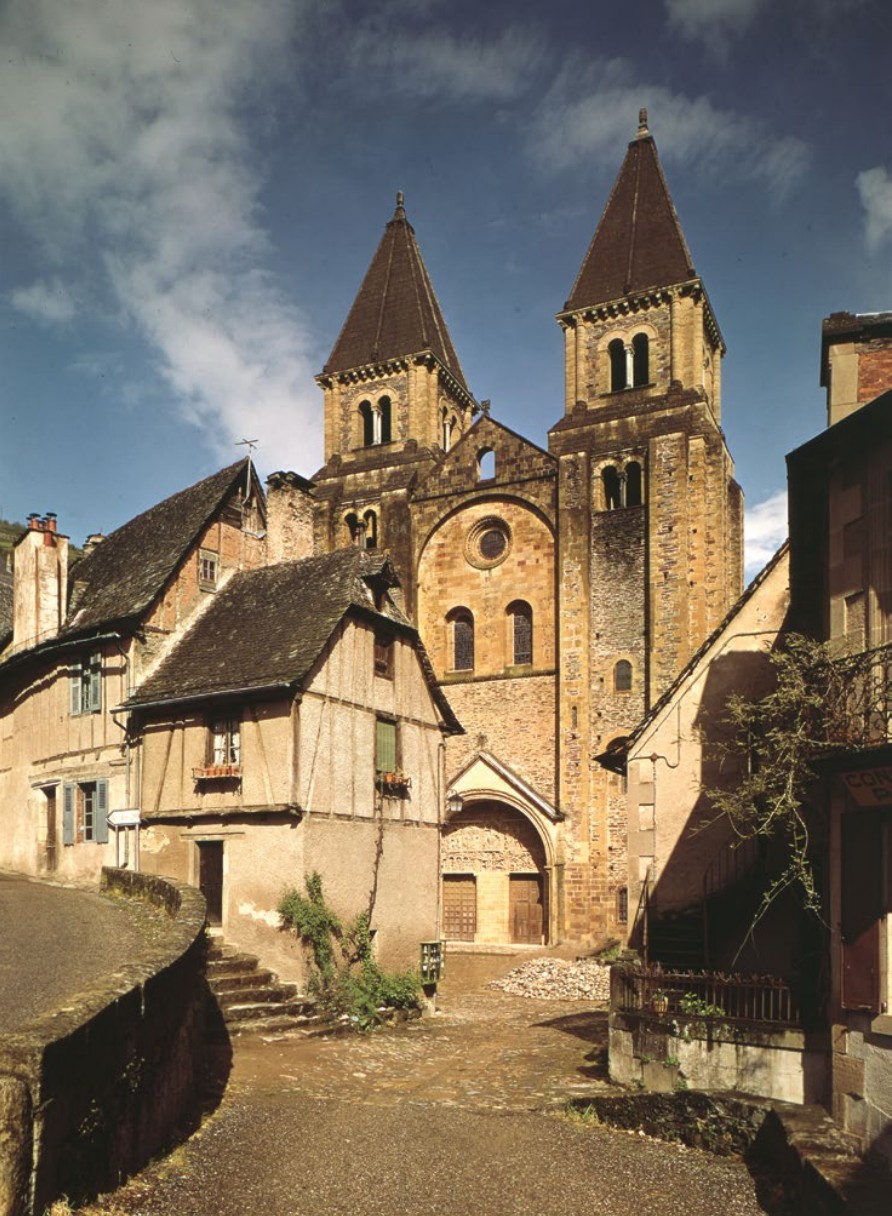
 Church of Sainte-Foy © Scala/Art Resource, NY
Church of Sainte-Foy
Conques, France. Romanesque Europe. Church: c. 1050–1130 C.E.; Reliquary of Saint Foy: ninth century C.E. Stone (architecture); stone and paint (tympanum); gold, silver, gemstones, and enamel over wood (reliquary).
Curator Note
"A key pilgrimage church on the route to Santiago de Compostela. It famously houses the Reliquary of Sainte-Foy, a gold statue containing the skull of a young martyr. The church’s architecture (wide transepts, ambulatory) was designed to handle large crowds of pilgrims. The "Last Judgment" tympanum warned them of hell."
Form
- Romanesque style: thick walls, rounded arches.
- Cruciform plan (cross shape).
- Barrel vaults reinforced by transverse arches.
- Radiating chapels for relics.
- Tympanum: crowded, hierarchical composition.
Function
- Pilgrimage church (to accommodate travelers).
- To house the relics of Sainte Foy.
- Monastic church for the abbey.
- Didactic: Tympanum teaches the illiterate about sin/salvation.
- To attract donations.
Content
- Reliquary: Gold statue of a seated girl, encrusted with gems (spolia).
- Tympanum: Christ in Majesty (center).
- Right side of Christ (our left): Saved/Heaven (orderly).
- Left side of Christ (our right): Damned/Hell (chaotic, demons).
- Sainte Foy prostrating before God.
Context
- Sainte Foy was a 12-year-old martyr killed by Romans.
- The monks "stole" her relics (furta sacra) to attract pilgrims.
- Located in Conques, a remote mountain village.
- Pilgrimage was a major economic and spiritual activity.
- The reliquary includes a Roman parade helmet face.