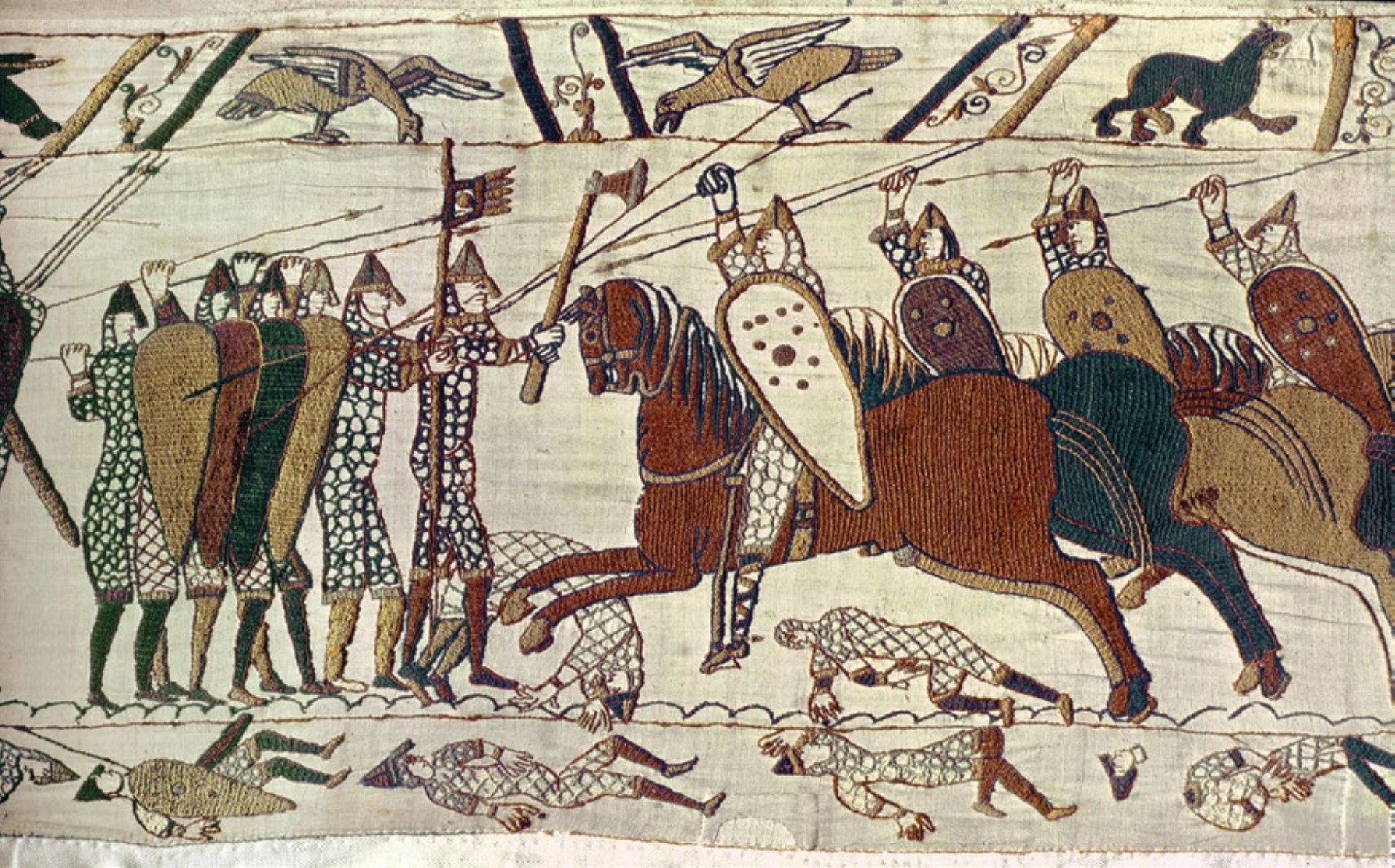
 Cavalry attack © Erich Lessing/Art Resource, NY
Bayeux Tapestry
Romanesque Europe (English or Norman). c. 1066–1080 C.E. Embroidery on linen.
Curator Note
"Not a tapestry, but an embroidery. A massive 230-foot long cloth telling the story of the Norman Conquest of England (1066) from the victor’s perspective (William the Conqueror). It reads like a comic strip, depicting the Battle of Hastings, Halley’s Comet, and daily life, justifying William’s claim to the throne."
Form
- Embroidery: wool yarn sewn onto linen cloth.
- 70 meters long, 50 cm high.
- Continuous narrative (frieze-like).
- Latin inscriptions (tituli) explain the scenes.
- Flat figures, limited colors (8 shades), linear style.
Function
- Propaganda: to legitimize William's conquest.
- To decorate the Bayeux Cathedral (or a palace).
- To record historical events (Battle of Hastings).
- To entertainment and instruct.
- Secular art in a religious setting.
Content
- Edward the Confessor's death.
- Harold Godwinson's oath to William (and betrayal).
- Building the fleet and crossing the Channel.
- Battle of Hastings: cavalry charges, shield wall.
- First depiction of dining, cooking, and Halley's Comet.
Context
- Commissioned by Odo, Bishop of Bayeux (William's half-brother).
- Made by skilled Anglo-Saxon needleworkers (women).
- Provides invaluable details on 11th-century armor and life.
- Shows the feudal relationship.
- Miraculously survived wars and revolution.