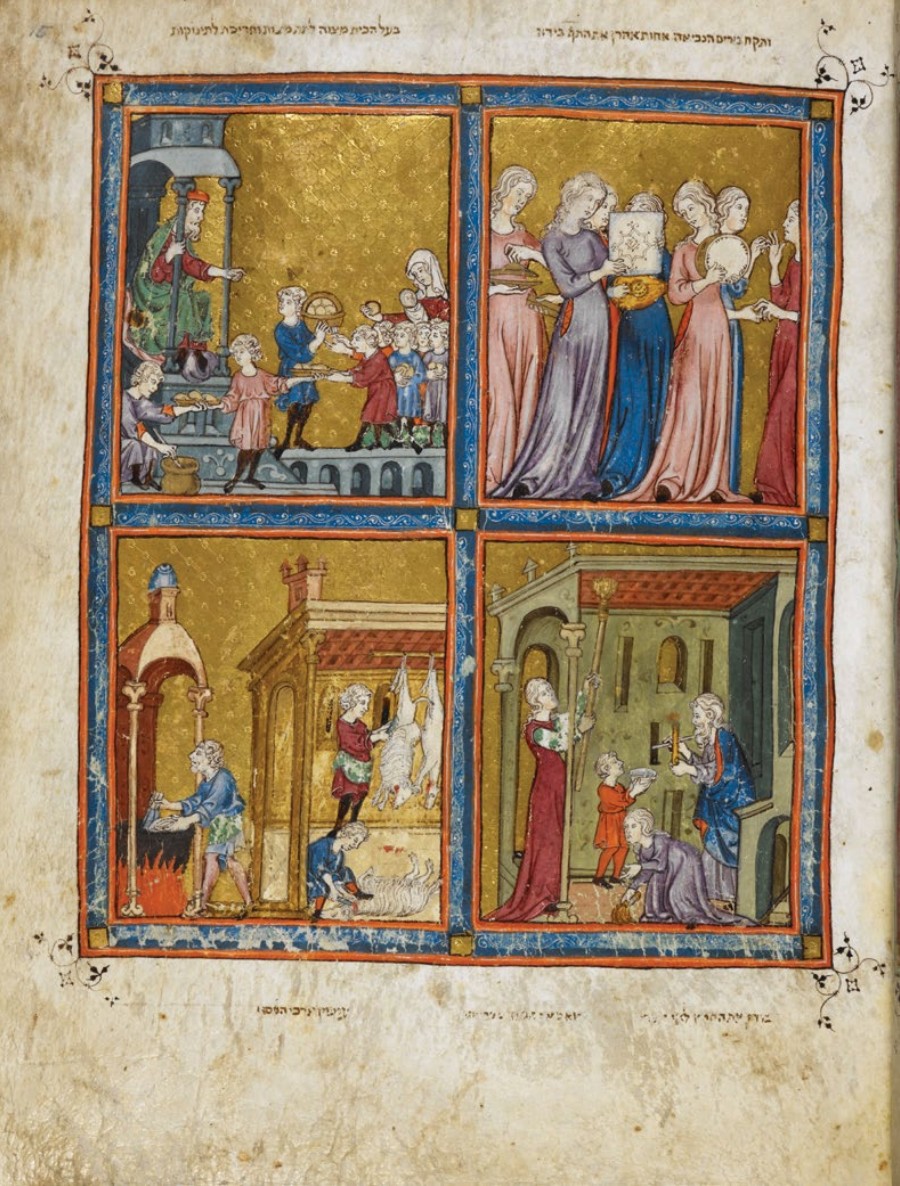
 The Plagues of Egypt © British Library/Robana/Hulton Fine Art Collection/Getty Images
Golden Haggadah
Late medieval Spain. c. 1320 C.E. Illuminated manuscript (pigments and gold leaf on vellum).
Curator Note
"A luxurious Jewish manuscript used at the Passover Seder. Created in medieval Spain (a multicultural hub), it reflects the Gothic style of Christian manuscripts of the time, showing the cross-cultural exchange. It depicts the Plagues of Egypt and the Liberation with heavy use of gold leaf."
Form
- Illuminated manuscript with gold leaf backgrounds.
- Gothic style figures (swaying, fashion).
- Read right to left (Hebrew).
- Series of 56 miniature paintings.
- Vivid colors and detailed narration.
Function
- Used during the Passover Seder (ritual meal).
- To tell the story of the Exodus from Egypt.
- Educational tool for the family.
- Display of wealth and status.
- To fulfill the commandment to "tell your son".
Content
- Scenes of the Plagues (frogs, lice, beasts).
- Liberation: Israelites crossing the Red Sea.
- Preparation for Passover (cleaning the house).
- Moses and Aaron.
- Women playing tambourines (Miriam).
Context
- Made in Catalonia (Barcelona), Spain.
- Jewish community was wealthy and integrated (pre-expulsion).
- Shows influence of French Gothic painting.
- Figurative art allowed in educational Jewish texts.
- Survived the expulsion of Jews from Spain in 1492.