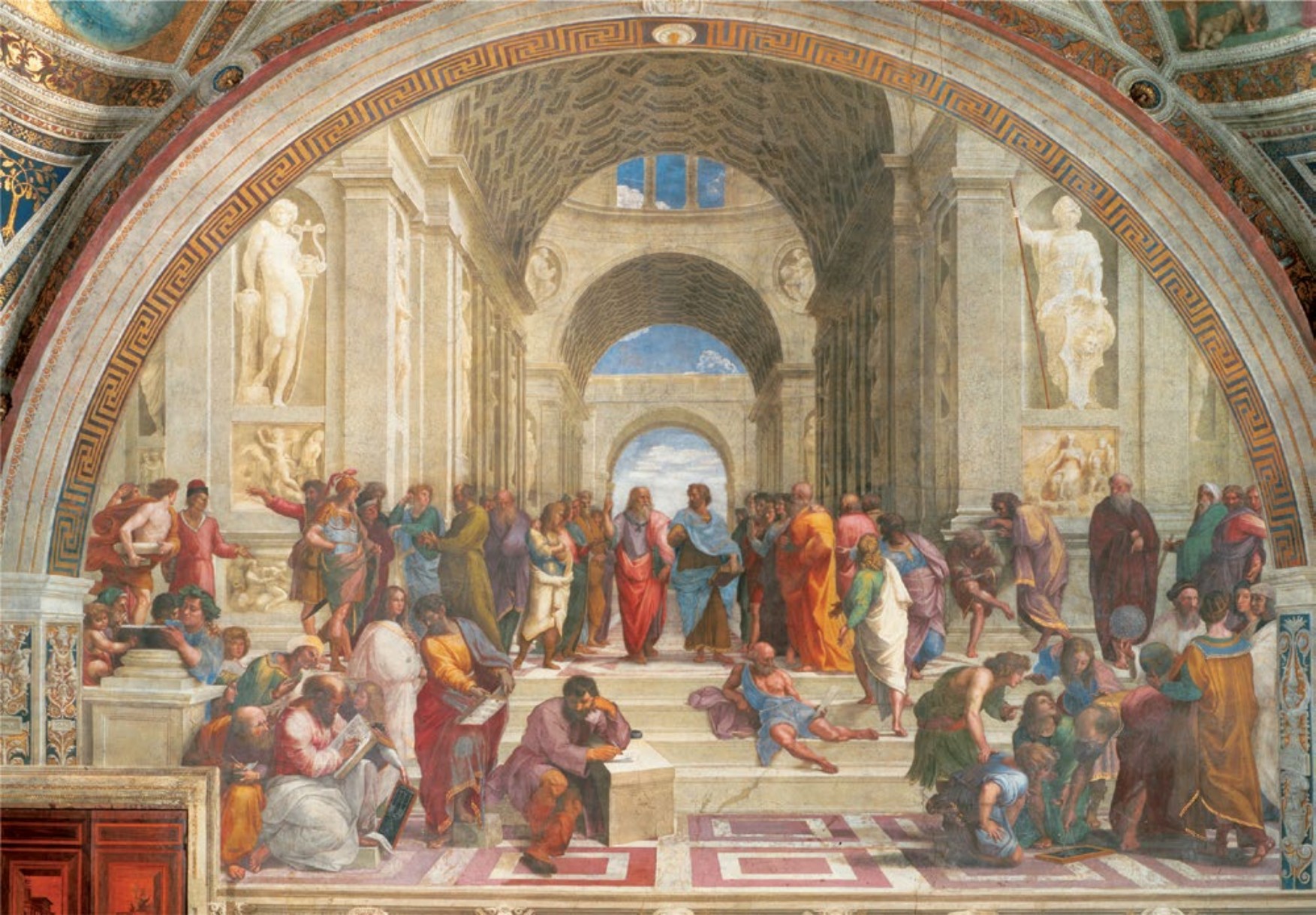
 School of Athens © The Bridgeman Art Library Ltd./Alamy
School of Athens
Raphael. 1509–1511 C.E. Fresco.
Curator Note
"The visual embodiment of the High Renaissance synthesis of Classical learning and Christian theology. Located in the Pope's library, it depicts the greatest philosophers of antiquity (Plato, Aristotle, Socrates) debating and thinking. Raphael projected the ideals of the papacy onto the wisdom of the ancients."
Form
- Fresco.
- Perfect linear perspective (vanishing point between Plato and Aristotle).
- Symmetrical composition.
- Grand architectural setting (based on Bramante's St. Peter's).
- Bright, clear colors and even light.
Function
- Decoration for the Stanza della Segnatura (Pope's library).
- To represent "Philosophy" (one of the four branches of knowledge).
- To show the harmony between Faith and Reason.
- To celebrate the intellectual golden age of Julius II.
- Propaganda for the Church as the heir to Rome.
Content
- Plato (pointing up, idealist) and Aristotle (palm down, realist).
- Heraclitus (brooding foreground figure, Michelangelo portrait).
- Euclid (drawing with compass, Bramante portrait).
- Raphael self-portrait (looking at viewer, far right).
- Statues of Apollo and Minerva overlooking the scene.
Context
- Painted at the same time Michelangelo was painting the Sistine Ceiling.
- Commissioned by Pope Julius II.
- Reflects Humanist respect for pagan wisdom.
- Raphael was known for his social grace (sprezzatura).
- The four walls represent: Philosophy, Theology, Poetry, Law.