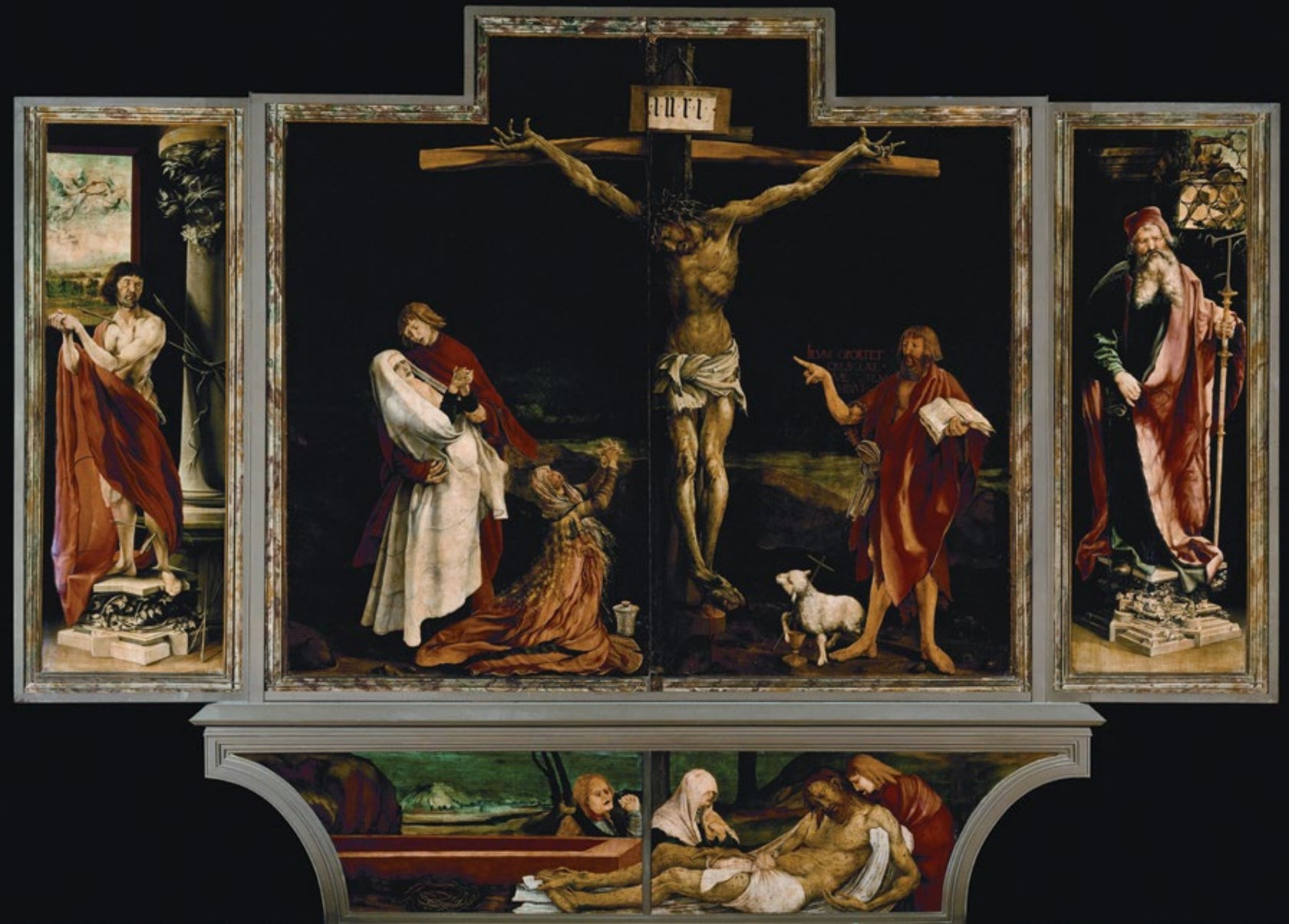
 Isenheim altarpiece, closed © Erich Lessing/Art Resource, NY
Isenheim altarpiece
Matthias Grünewald. c. 1512–1516 C.E. Oil on wood.
Curator Note
"A polyptych created for a hospital treating victims of St. Anthony’s Fire (ergotism), a painful skin disease. Unlike the idealized Italian Christ, Grünewald’s Crucifixion shows a sickly, green, pockmarked Jesus, offering comfort to the patients by showing that God understands their suffering."
Form
- Polyptych (many panels) with multiple views/configurations.
- Oil on wood.
- Expressionist color (greenish skin, dark sky).
- Distorted figures for emotional impact.
- Gothic horror mixed with Renaissance realism.
Function
- Altarpiece for the monastery hospital of St. Anthony.
- Therapeutic: to comfort dying patients.
- Didactic: opened on Sundays/Feast days to show the Resurrection.
- To inspire hope (Resurrection panel is blindingly bright).
- Liturgical centerpiece.
Content
- Closed: The Crucifixion (Nightmare scene).
- John the Baptist pointing: "He must increase, but I must decrease."
- Lamb of God bleeding into a chalice.
- Open: Annunciation, Nativity, Resurrection (psychedelic light).
- St. Sebastian and St. Anthony (healer saints) on wings.
Context
- St. Anthony's Fire caused hallucinations and gangrene.
- Border of France/Germany (Alsace).
- Pre-Reformation mysticism.
- Contrasts heavily with Italian idealism (e.g., Raphael).
- Saved during wars and now in a museum (Colmar).