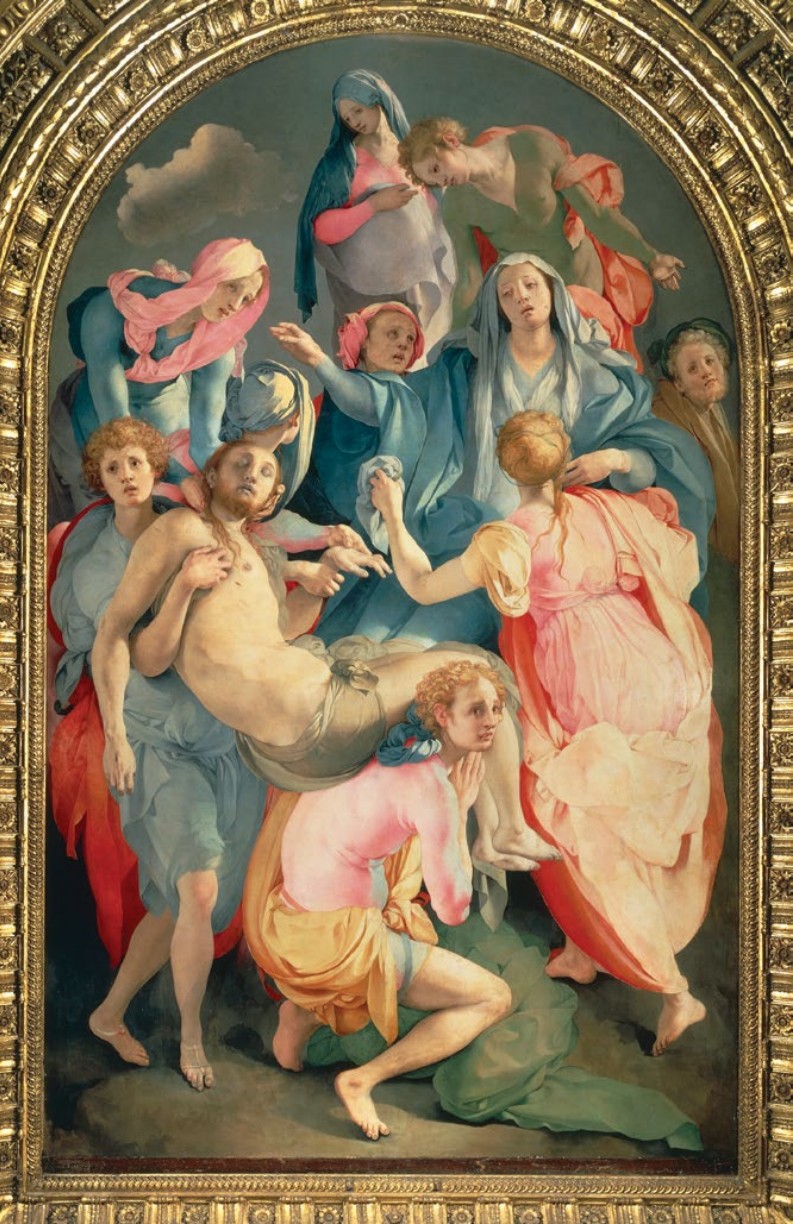
 Entombment of Christ © De Agostini Picture Library/The Bridgeman Art Library
Entombment of Christ
Jacopo da Pontormo. 1525–1528 C.E. Oil on wood.
Curator Note
"A prime example of Mannerism, the style that followed the High Renaissance. Pontormo deliberately rejects the balance and stability of the Renaissance. The composition has no center, figures are elongated and twisted in impossible poses, and the colors are jarringly bright pinks and blues. It reflects a world turned upside down by the Reformation."
Form
- Mannerist style.
- Void in the center of the composition.
- Elongated, twisting figures (figura serpentinata).
- Acidic, pastel colors (pink, blue, orange).
- No sense of weight or ground line (figures float).
Function
- Altarpiece for the Capponi Chapel in Santa Felicità.
- To shock the viewer with its strangeness.
- To express spiritual anxiety.
- Private commission.
- Departure from the norm.
Content
- Christ being carried (to the tomb? or deposed?).
- Mary swooning.
- Figures look distraught and anxious.
- Pontormo self-portrait (face on right edge).
- Ambiguous space (no cross, no tomb visible).
Context
- Florence after the height of the Renaissance.
- Reformation and Sack of Rome caused instability.
- Mannerism = "Maniera" (Style/Artificiality).
- Rejects nature for "art".
- Located in a small, dark chapel (colors pop).