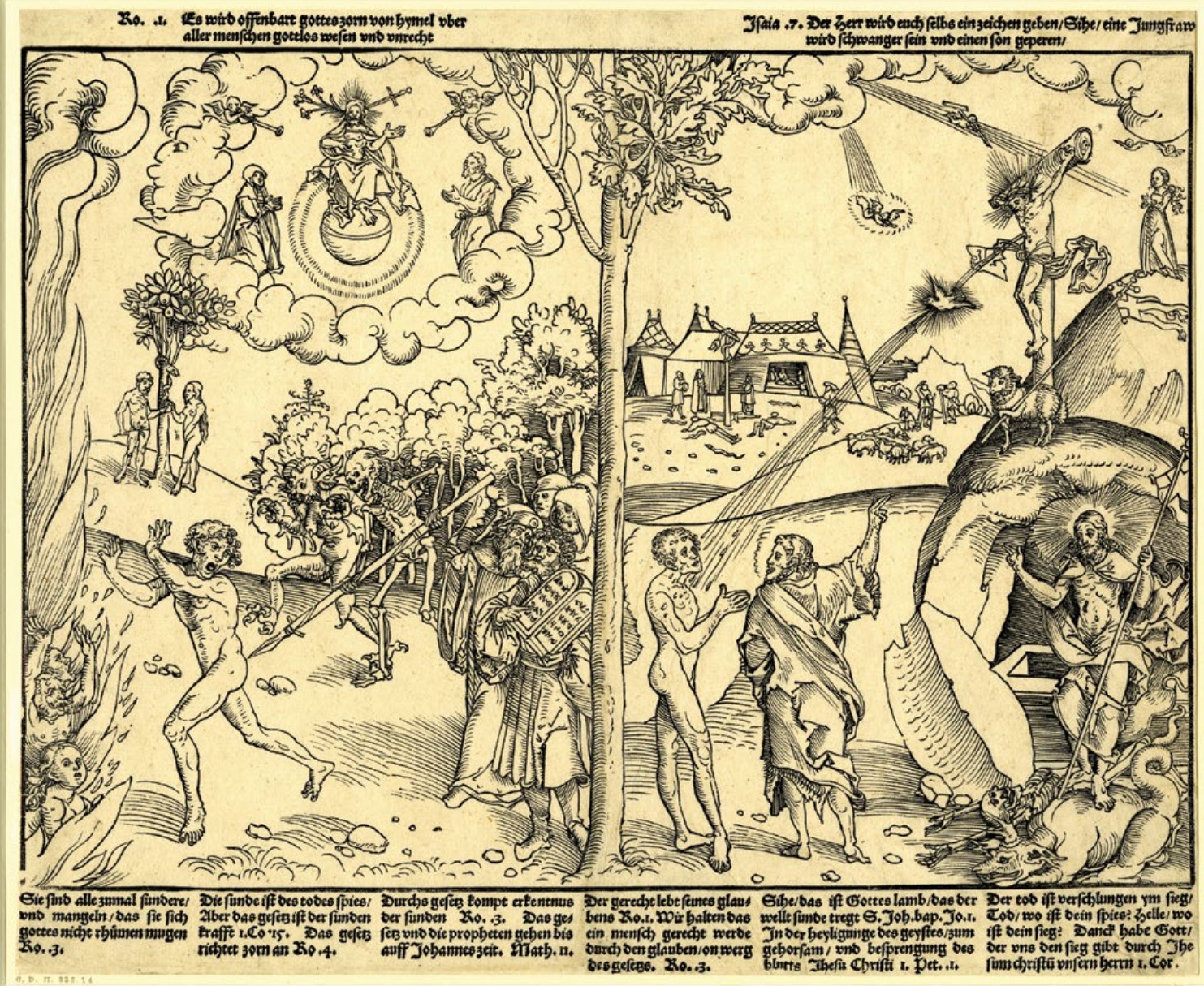
 Allegory of Law and Grace © The Trustees of the British Museum/Art Resource, NY
Allegory of Law and Grace
Lucas Cranach the Elder. c. 1530 C.E. Woodcut and letterpress.
Curator Note
"A visual manifesto of the Protestant Reformation. Cranach, a close friend of Martin Luther, contrasts Catholicism (Law) with Lutheranism (Grace). On the left, a man tries to reach heaven by following rules but is damned. On the right, a man simply has faith in Christ and is saved. It teaches "Sola Fide" (Faith Alone)."
Form
- Woodcut print (mass producible).
- Divided composition (Left vs. Right).
- Text (German bible verses) included at bottom.
- Didactic, illustrative style.
- Linear and graphic.
Function
- Propaganda for the Lutheran Reformation.
- To teach the illiterate the difference between Catholic and Protestant theology.
- To critique the Catholic emphasis on "works".
- Cheap distribution.
- Theological diagram.
Content
- Tree: Dead on Law side, leafy on Grace side.
- Left (Law): Moses with commandments, Adam and Eve sinning, Man chased into hell by death/devil.
- Right (Grace): John the Baptist points to Christ, Blood of Christ creates a fountain of salvation.
- Holy Spirit (dove).
- Lamb of God.
Context
- Martin Luther started the Reformation in 1517.
- Cranach was the "painter of the Reformation".
- Woodcuts were the "social media" of the 16th century.
- Rejection of religious imagery as idolatry (except for teaching).
- Shift from Latin to vernacular (German).