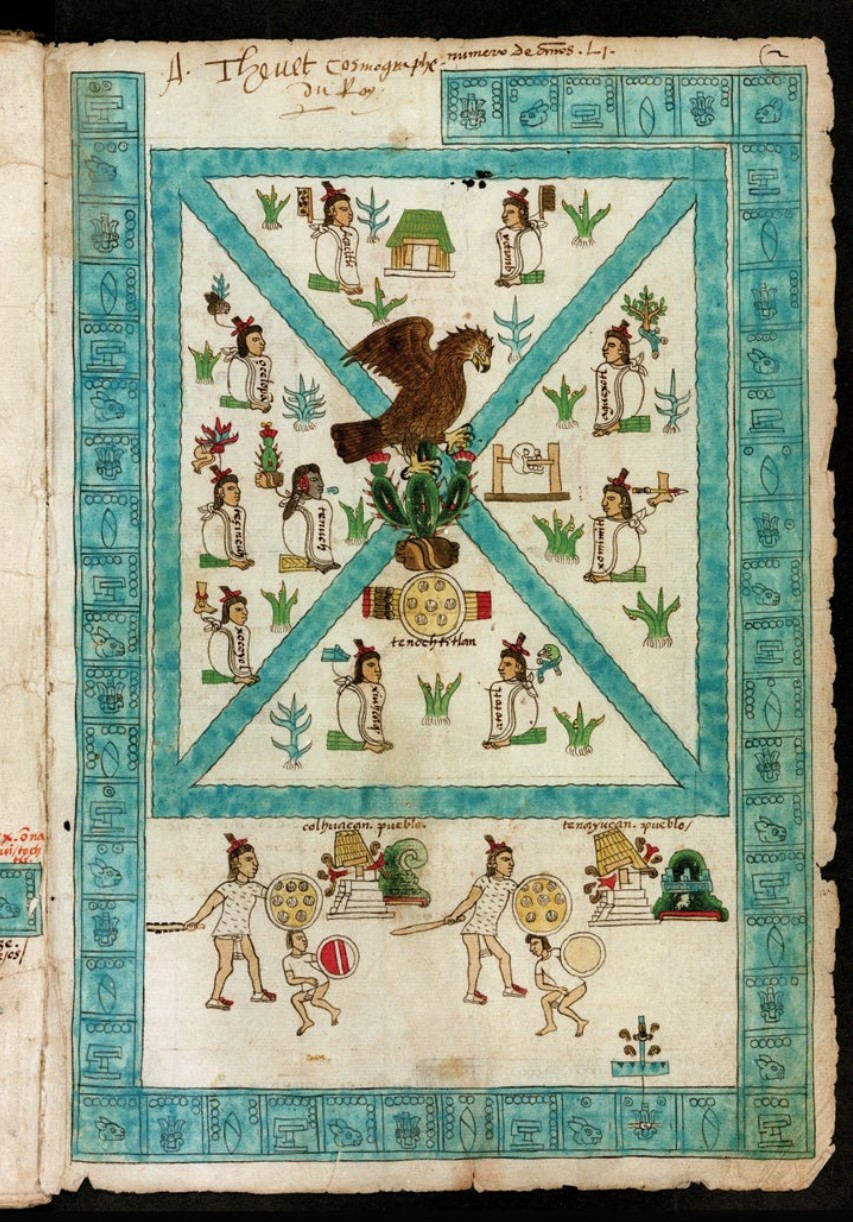
 Frontispiece of the Codex Mendoza © The Bodleian Libraries, The University of Oxford
Frontispiece of the Codex Mendoza
Viceroyalty of New Spain. c. 1541–1542 C.E. Ink and color on paper.
Curator Note
"A manuscript ordered by the Spanish Viceroy to inform the King of Spain about his new subjects. Created by indigenous Aztec artists under Spanish supervision, it depicts the founding legend of Tenochtitlan (eagle on a cactus) and the history of Aztec conquests. It creates a visual history that validates Spanish rule while preserving Aztec culture."
Form
- Codex (book format).
- Aztec pictograms combined with Spanish text (glosses).
- Flat, stylized figures.
- Hierarchical scale (victors larger than losers).
- Geometric layout (X shape for canals).
Function
- To record Aztec history and tribute for Emperor Charles V.
- To justify the conquest (showing Aztec power).
- Encyclopedic documentation.
- Never reached Spain (stolen by French pirates).
- Example of colonial hybrid art.
Content
- Eagle on cactus: The sign from Huitzilopochtli to build the city.
- Blue diagonal lines: Canals of Tenochtitlan.
- Tenoch (founder) and other chiefs.
- Bottom register: Aztec warriors conquering other towns (Colhuacan).
- Skull rack (Tzompantli).
Context
- Created 20 years after the conquest.
- Aztec scribes (tlacuilos) used traditional style.
- Paper was European (or maguey).
- Shows the eagle myth which is now on the Mexican flag.
- The Viceroy Mendoza commissioned it.