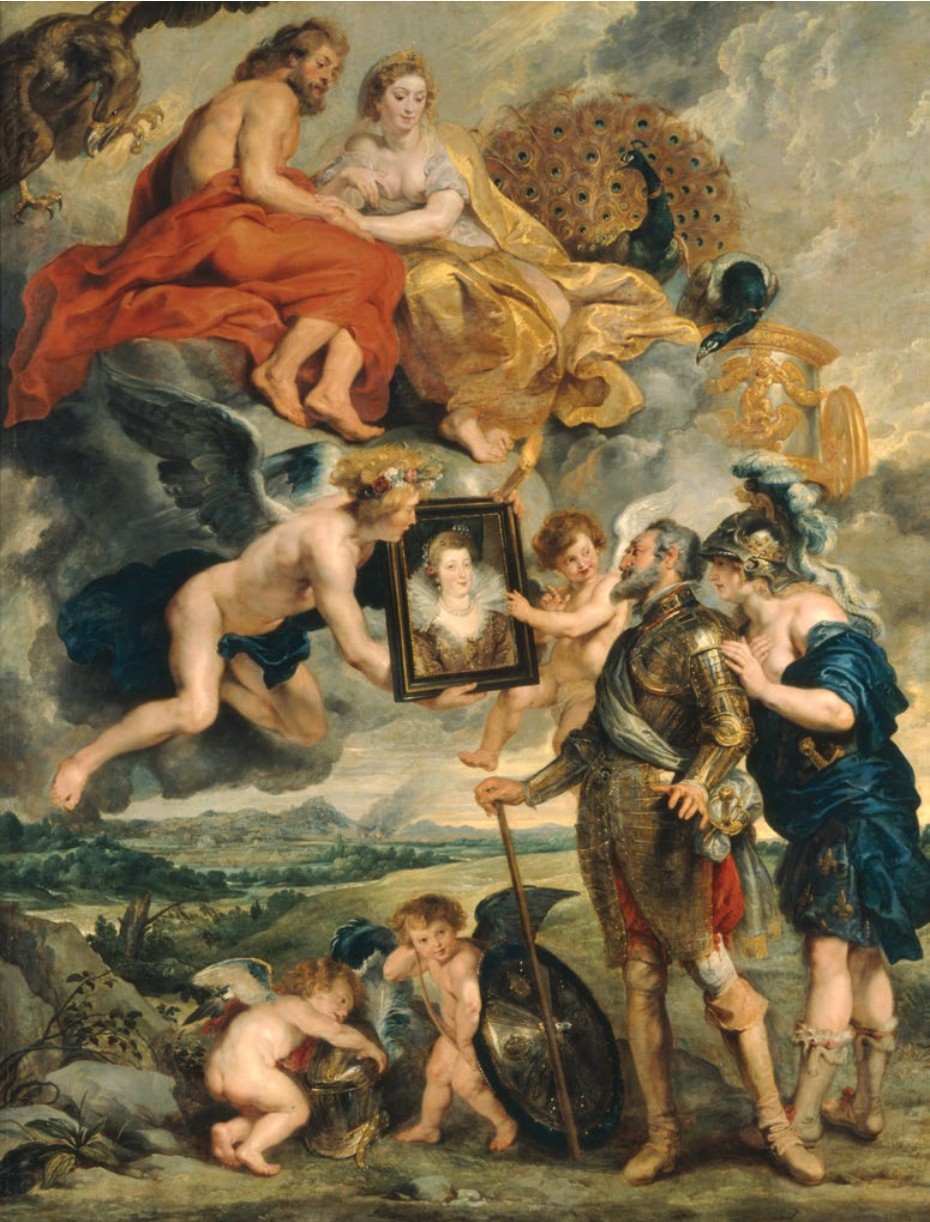
 Henri IV Receives the Portrait of Marie de' Medici © RMN-Grand Palais/Art Resource, NY
Henri IV Receives the Portrait of Marie de' Medici
Peter Paul Rubens. 1621–1625 C.E. Oil on canvas.
Curator Note
"Part of a massive 24-painting cycle commissioned by Marie de' Medici (Queen of France) to glorify her rather boring life. Rubens uses mythology to spice it up: Gods and allegorical figures convince King Henri IV that falling in love with Marie’s portrait is not just personal, but a matter of national importance."
Form
- Baroque dynamism (swirling movement).
- Rich, vibrant colors (Rubenesque).
- Combination of real portraits and mythological figures.
- Diagonal composition.
- Loose, painterly brushwork.
Function
- Propaganda: to legitimize Marie's rule as Regent.
- To decorate the Luxembourg Palace.
- To convince the French she was divinely chosen.
- To gloss over her political failures.
- To celebrate portions of her life.
Content
- Henri IV: appearing smitten by the portrait.
- Hymen (God of Marriage) and Amor (Cupid): presenting the photo.
- Jupiter and Juno (King/Queen of Gods): looking down approvingly.
- France (personification): whispering to Henri to marry her.
- Battle smoke in back: Henri leaving war for love.
Context
- Marie was unpopular and exiled by her son.
- Rubens was the most famous painter in Europe (and a diplomat).
- The marriage was actually a political arrangement.
- Flemish Baroque style serving French royalty.
- Rubens had a massive workshop.