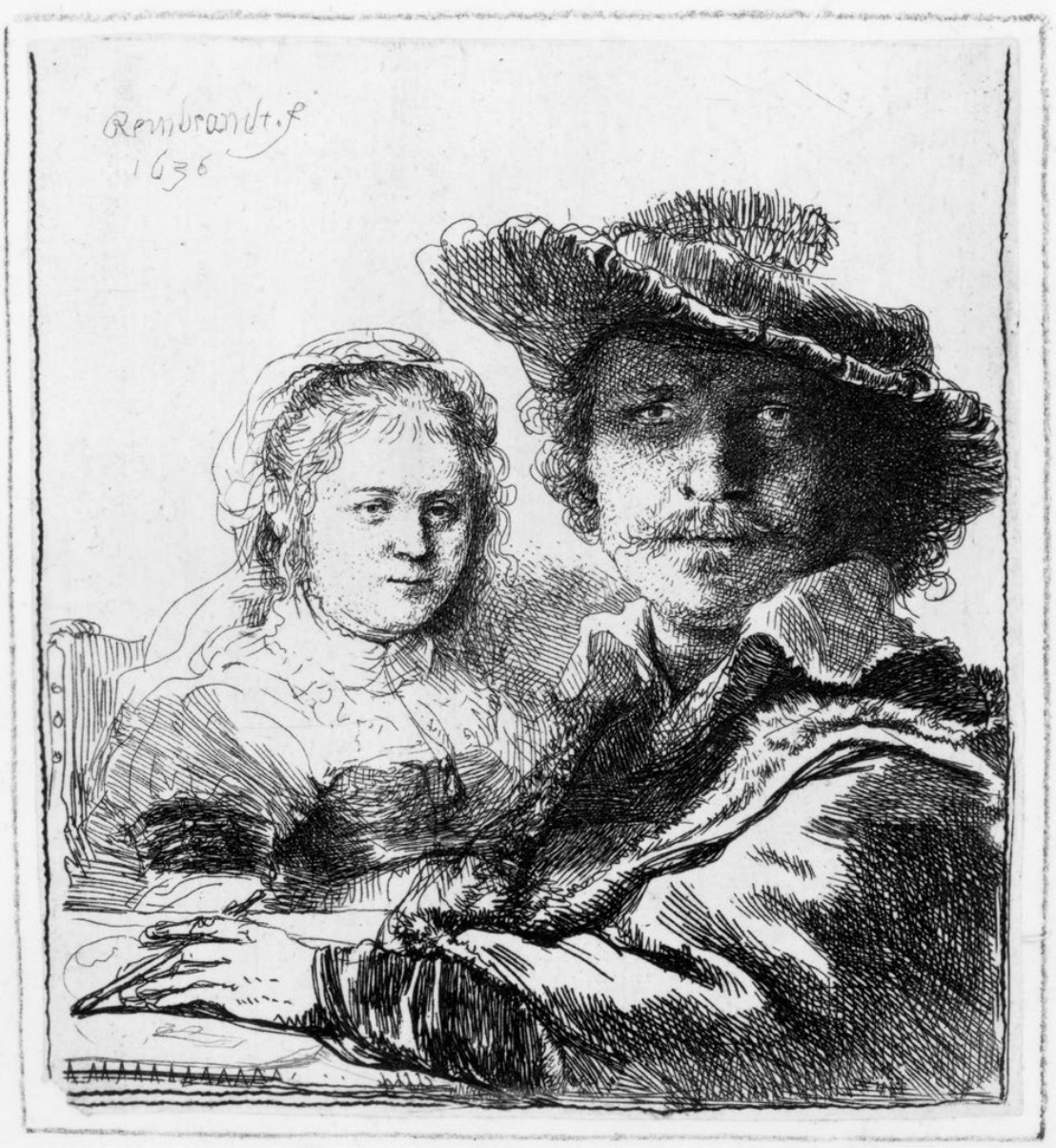
 Self-Portrait with Saskia © The Pierpont Morgan Library/Art Resource, NY
Self-Portrait with Saskia
Rembrandt van Rijn. 1636 C.E. Etching.
Curator Note
"An intimate etching of the Dutch master and his wife. Unlike typical formal portraits, this is a "marriage portrait" of the artist at work, with Saskia seated behind him as his muse. It captures a moment of personal happiness and professional confidence, using Rembrandt’s signature mastery of light and line."
Form
- Etching (printmaking using acid).
- Sketchy, spontaneous lines.
- Control of tone (light and shadow) via hatching.
- Different "states" (versions).
- Small scale.
Function
- Private image of the couple.
- Study of expressions and composition.
- To present himself as an artist.
- Not a commissioned formal portrait.
- To explore the relationship between artist and muse.
Content
- Rembrandt: drawing, wearing a fanciful hat (historical costume).
- Saskia: seated further back, lighter touch.
- The action: looking in a mirror to draw himself.
- Theme: Love and Art.
- Psychological depth.
Context
- Rembrandt was the master of the Dutch Golden Age.
- Saskia was wealthy; her marriage raised his status.
- She died young; this records their happy years.
- Rembrandt made more self-portraits than anyone else.
- Etching allowed for artistic freedom.