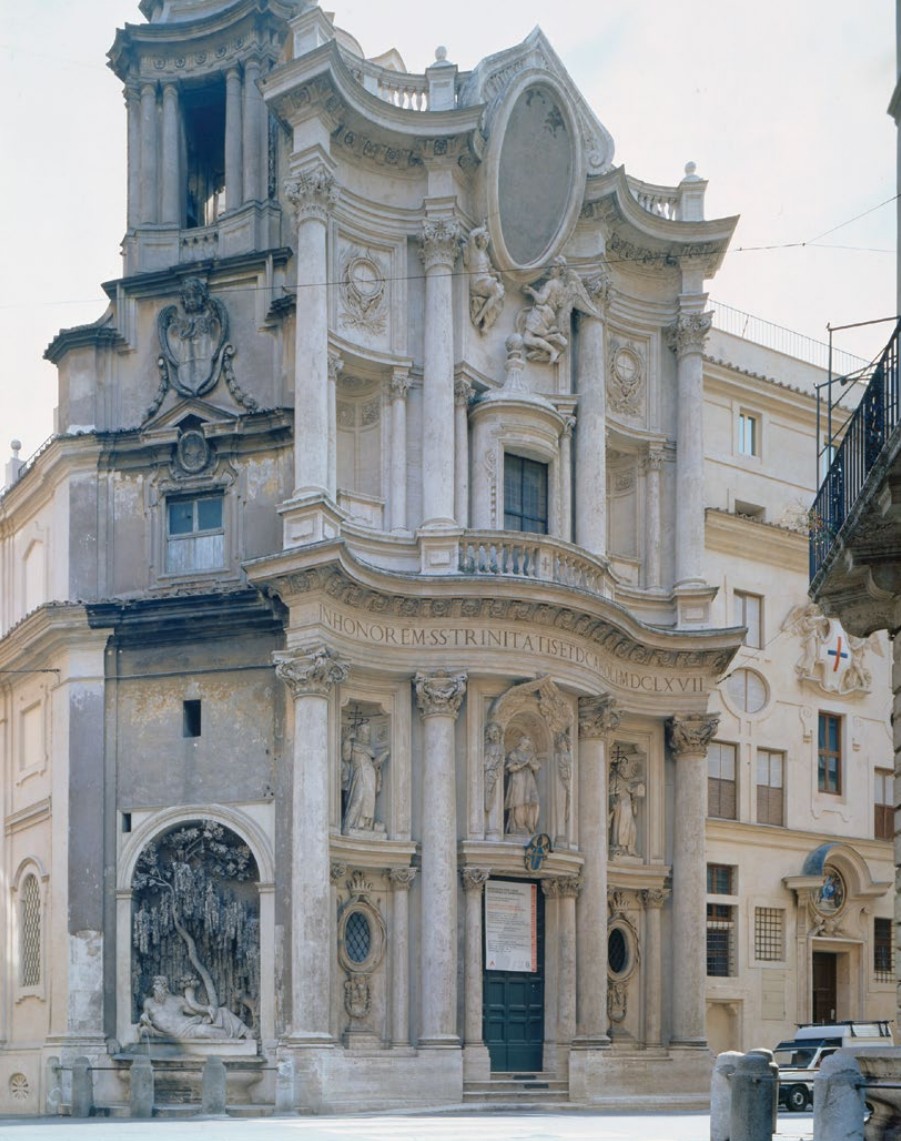
 San Carlo alle Quattro Fontane © Scala/Art Resource, NY
San Carlo alle Quattro Fontane
Rome, Italy. Francesco Borromini (architect). 1638–1646 C.E. Stone and stucco.
Curator Note
"A small church that packs a massive punch. Borromini, a rival of Bernini, treats the architecture like sculpture. The facade undulates in a wave-like motion (concave-convex), and the interior dome is an oval with complex geometric coffers (crosses, hexagons, octagons). It is the pinnacle of Baroque mathematical complexity."
Form
- Undulating facade (concave-convex-concave).
- Oval plan (dynamic) rather than circle (static).
- Complex geometric coffers in the dome.
- All white interior (monochromatic).
- Small footprint (fits inside one pier of St. Peter's).
Function
- Church for the Trinitarian Order (dedicated to freeing slaves).
- To fit a church on a tiny, awkward corner.
- To impress with mathematical virtuosity.
- To challenge the Renaissance static ideals.
- Devotion to the Trinity.
Content
- Dome: Hidden windows make it float; Holy Spirit dove at apex.
- Facade: Statue of San Carlo Borromeo.
- Columns: Giant order.
- Geometry: Based on two equilateral triangles.
- The "Four Fountains" are on the street corners.
Context
- Borromini was eccentric and depressive (committed suicide).
- Rome was the center of Baroque innovation.
- Trinitarians had little money; used stucco, not marble.
- Revolutionized architectural wall surface.
- Contrast with Bernini's theatricality.