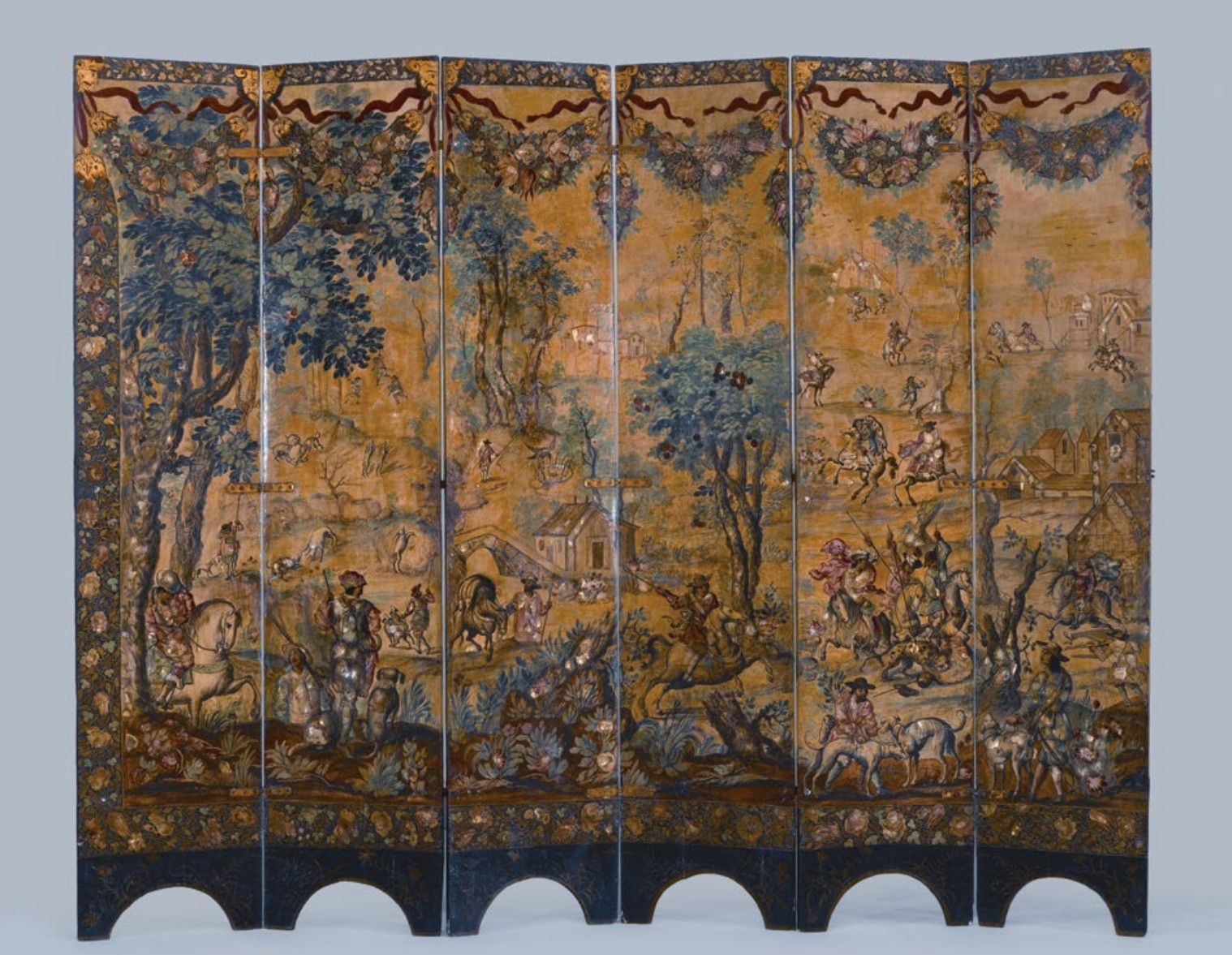
 Screen Belgrade © González Family. Folding Screen with the Siege of Belgrade (front) and Hunting Scene (reverse), ca.1697-1701. Oil on wood, inlaid with mother-of pearl, 90 1/2 x 108 5/8 in. (229.9 x 275.8 cm). Brooklyn Museum, Gift of Lilla Brown in memory of her husband John W. Brown, by exchange, 2012.21
Screen with the Siege of Belgrade and hunting scene
Circle of the González Family. c. 1697–1701 C.E. Tempera and resin on wood, shell inlay.
Curator Note
"A folding screen (biombo) that embodies the global trade network of New Spain (Mexico). Inspired by Japanese screens (byobu), it features a European war scene on one side (for men/politics) and a decorative hunting scene on the other (for women/tea). It uses "enconchado" (mother-of-pearl inlay), a Mexican technique."
Form
- Biombo (folding screen).
- Enconchado: Shell inlay (shimmering).
- Asian influence (lacquer style, floral border).
- European subject matter.
- Tempera and resin.
Function
- Room divider in the Viceregal palace.
- War side: To impress male visitors with Hapsburg power.
- Hunt side: To entertain women/guests in private quarters.
- Diplomatic gift.
- Display of cosmopolitan taste.
Content
- Siege of Belgrade: Hapsburgs vs. Ottomans (Christian victory).
- Hunting Scene: Based on Medici tapestries.
- Shells: Create a jewel-like surface.
- Japanese floral patterns on the border.
- Chaotic battle vs. peaceful nature.
Context
- Manila Galleon trade brought Asian goods to Mexico.
- Mexico City was a global crossroads.
- Viceroy José Sarmiento de Valladares owned it.
- Example of "Mestizo" or hybrid art.
- Japonisme before the 19th century.