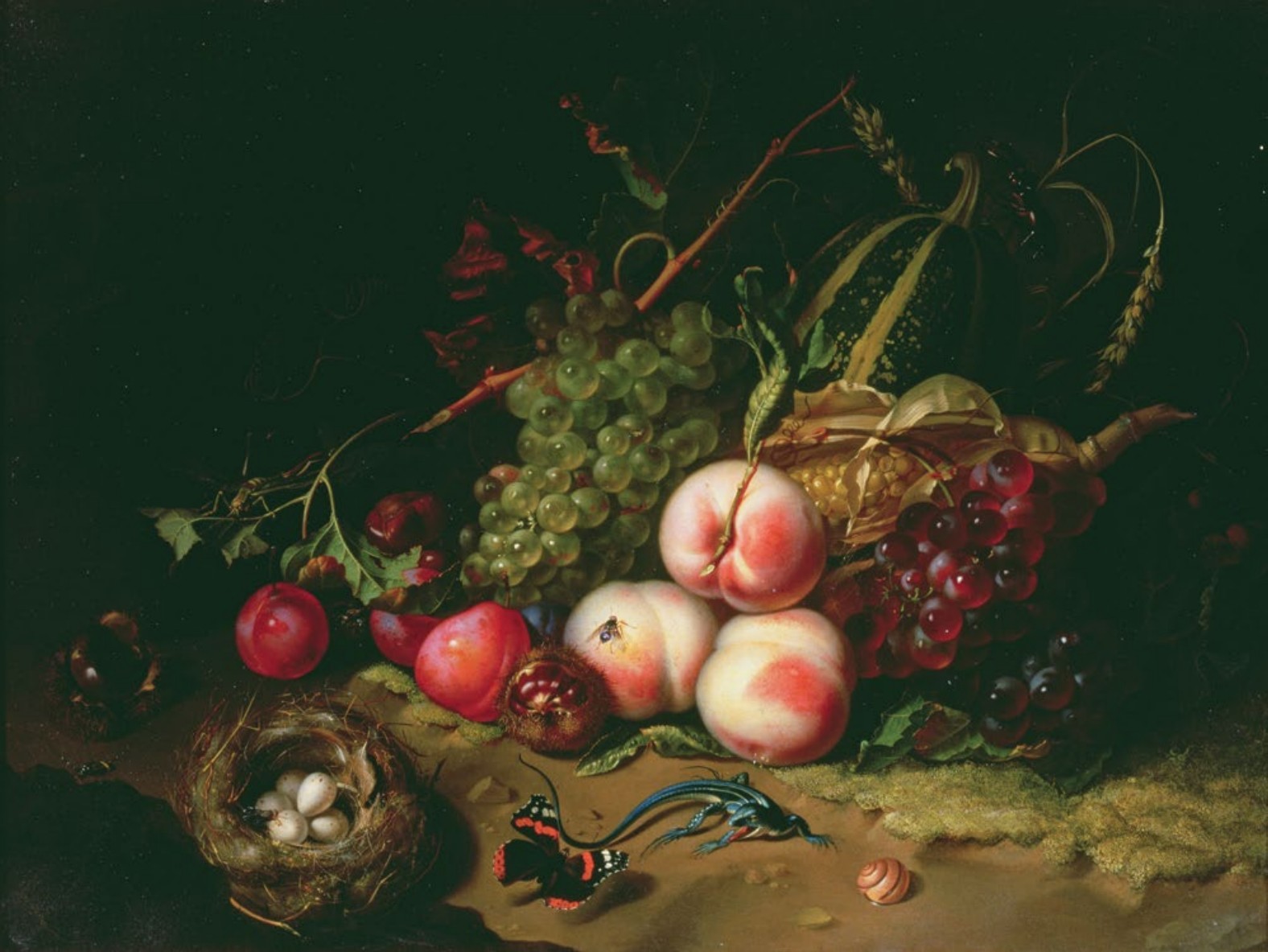
 Fruit and Insects © Galleria degli Uffizi, Florence, Italy/The Bridgeman Art Library
Fruit and Insects
Rachel Ruysch. 1711 C.E. Oil on wood.
Curator Note
"A scientific yet symbolic still life by a successful female Dutch artist. Ruysch specializes in flowers and fruits, painting them with microscopic accuracy (her father was a botanist). The composition is a "Vanitas": the grapes are ripe, but insects are eating them, and eggs are hatching. Life is cycle of decay and rebirth."
Form
- Still life painting.
- Geometric composition (diagonals).
- Tenebrism (spotlight effect).
- Microscopic realism.
- Autumnal colors.
Function
- Commissioned for the Medici family (Cosimo III).
- Decoration.
- Moral lesson (Vanitas/Memento Mori).
- Scientific study of nature.
- Display of technical virtuosity.
Content
- Autumn harvest: Grapes, wheat, squash, corn.
- Christian symbols: Wheat/Grapes = Eucharist.
- Insects: Butterfly (soul/resurrection), Lizard/Beetle (decay/sin).
- Bird's nest with eggs: New life.
- Rotting fruit: Transience.
Context
- Dutch still lifes were hugely popular.
- Ruysch was an international celebrity artist.
- Her father had a cabinet of curiosities.
- Microscope was invented in Holland.
- Women could excel in still life (couldn't study nudes).